
Many buyers use the term fluidized bed opposed jet mill when they need an ultra-fine powder route, but the name alone is not enough for a reliable quotation. The real decision depends on feed size, target D50/D90/D97, compressed-air supply, classifier control, collection scope, material behavior and testing assumptions.
This article explains what a buyer should confirm before requesting a quotation for a fluidized bed opposed jet mill. It does not claim a guaranteed capacity, purity level, energy saving or delivery time. Those details still need material data, sample testing and final engineering review.
Quick Answer
- A fluidized bed opposed jet mill uses high-speed air jets to make particles collide with each other, then uses classification to separate qualified fine powder from coarse material.
- A quotation should define the target PSD, feed size, capacity basis, compressed-air condition, collection scope, contact material and testing assumptions.
- The technology is often considered for fine, heat-sensitive or contamination-sensitive powders, but suitability still depends on material behavior and test results.
- Buyers should compare complete systems, not only mill model names, because the compressor boundary, classifier, cyclone, filter, controls and discharge plan change the real scope.
How a Fluidized Bed Opposed Jet Mill Works
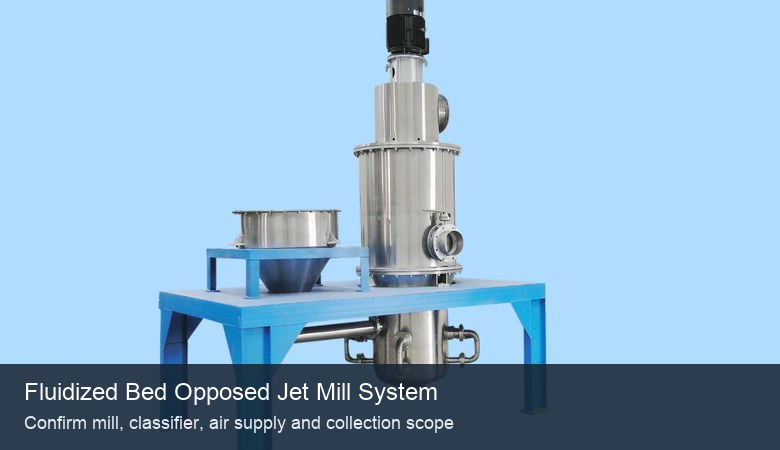
In a fluidized bed opposed jet mill, dried compressed air accelerates through nozzles into the grinding chamber. The powder is suspended and accelerated by the airflow. Instead of relying mainly on a mechanical rotor in the grinding zone, particle reduction comes from particle-to-particle impact inside the jet stream.
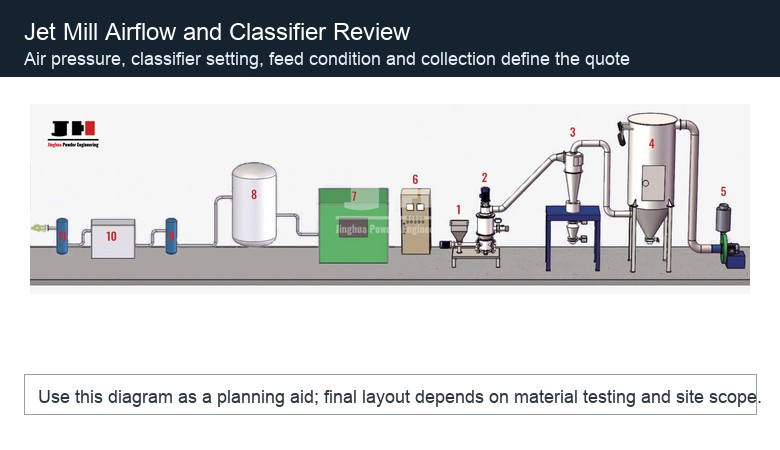
After grinding, the airflow carries powder toward the classification area. A classifier wheel or classification stage rejects oversized particles and allows qualified fine powder to leave the mill. The coarse fraction returns for more grinding, while the accepted powder moves to cyclone and bag-filter collection. This is why the mill, classifier, air supply and collection equipment must be discussed as one system.
Mills Powder’s Jet Mill product material lists a built-in turbo classifying wheel, no rotating device in the grinding section, compact structure and PLC control. It also lists model capacities, air consumption and fineness ranges as product parameters. Those references support planning, but they are not a substitute for confirming the buyer’s material and test basis.
When This Jet Mill Route Usually Fits
A fluidized bed opposed jet mill is usually worth evaluating when the buyer needs fine powder, narrow particle-size distribution, low mechanical grinding contact or limited heat generation in the grinding zone. Common planning categories include chemicals, pharmaceuticals, battery materials, abrasives, non-metallic minerals, ceramics, pigments and food additives. The product list alone does not prove that every material in those categories will run well; it only shows where the route is commonly considered.
This route is also useful when the buyer needs a controlled top cut. The built-in classification stage can help reject oversized particles, but D97 stability still depends on feed consistency, material flowability, classifier setting, airflow, collection and wear condition. Buyers with a strict coarse-particle limit should describe the requirement as D90, D97 or top cut instead of only saying a micron number.
For a buyer who is still comparing routes, the core Mills Powder Jet Mill page is the best product reference. Buyers working with low-melting or temperature-sensitive powders can also review Mills Powder’s article on air jet mill selection for heat-sensitive powders.
When It May Not Be the First Choice
A jet mill is not automatically the best route for every powder. If the target is coarse grinding, if the material is wet or sticky, if the plant cannot support the required compressed-air system, or if the buyer mainly needs lower capital cost for moderate fineness, another milling route may be more practical.
The buyer should also check whether the required capacity is realistic for a compressed-air grinding route. Jet mill capacity depends on grindability, feed size, target fineness, air volume, pressure, classifier setting and collection efficiency. A catalog table can guide model selection, but the final quotation should state the assumptions behind any capacity estimate.
If the powder already has the correct size range and only needs separation or coarse-particle removal, a standalone air classifier may be the more direct route. If the buyer needs fine grinding with mechanical impact and integrated classification, an air classifying impact mill may be considered. The important point is to define the process job before asking for a model name.
Quotation Inputs Buyers Should Prepare
Before requesting a quotation, the buyer should prepare the following information. These inputs help the supplier avoid quoting an incomplete system or assuming a capacity basis that does not match production conditions.
| Input to confirm | Why it matters | What to send |
|---|---|---|
| Material and application | Different powders have different hardness, abrasiveness, heat behavior, flowability and contamination limits. | Material name, industry, downstream use and any safety notes. |
| Feed condition | Large, wet or unstable feed can reduce grinding stability and may require pre-crushing or conditioning. | Feed size range, moisture, bulk density and whether the feed is agglomerated. |
| PSD target | D50 alone does not control the coarse tail, and D97 or top cut may decide product quality. | Target D50, D90, D97 or mesh, plus a current particle-size report if available. |
| Capacity basis | Feed rate, accepted fine-product output and system throughput are not the same number. | Required kg/h and whether it refers to feed or qualified product. |
| Air and utility boundary | Compressed air is a major part of jet milling scope and operating cost. | Available pressure, air volume, dryer condition and whether compressor supply is included. |
| Collection and controls | Cyclone, bag filter, discharge valve, control cabinet and dust handling change the quotation scope. | Expected packaging, dust control, automation and site requirements. |
How to Compare Quotations Without Being Misled
Two quotations can look similar if both say fluidized bed opposed jet mill, but they may describe different systems. One quote may include feeder, mill, classifier, cyclone, bag filter, valves, control cabinet and commissioning support. Another may include only the mill body and basic accessories. The buyer should compare the system boundary line by line.
The same care applies to capacity. Ask whether capacity means feed input or qualified product output. Ask which target PSD, air pressure, classifier setting and material condition were assumed. If the supplier cannot state these assumptions, the capacity number is difficult to use for engineering comparison.
For buyers moving from lab work to production, the article on jet mill micronizer selection from lab test data explains how test findings should become a production specification. For buyers who have not tested material yet, powder sample testing before equipment selection is a better starting point.
Common Specification Mistakes
- Asking for a mill model before defining feed size and target PSD.
- Using only an average micron size and ignoring D90, D97 or top cut.
- Comparing capacity numbers without checking whether they mean feed rate or accepted fine-product output.
- Forgetting compressed air, dryer, filter, cyclone, discharge and control-system scope.
- Assuming that one test result guarantees full production capacity without confirming scale-up conditions.
- Treating contact material, cleaning access and contamination limits as afterthoughts.
FAQ
Is a fluidized bed opposed jet mill the same as an air jet mill?
It is a type of air jet milling route. Buyers use several terms, including air jet mill, micronizer jet mill and jet milling machine. The important engineering question is whether the system uses compressed air jets, classification and collection in a configuration that fits the material and target PSD.
Can this type of jet mill guarantee D97 2 micron powder?
No quotation should guarantee a D97 target without material confirmation. Mills Powder’s product material lists a fineness planning range down to D97 equals 2 micron, but the achievable result depends on the material, feed size, moisture, air condition, classifier setting and test result.
What is the main cost boundary in a jet mill system?
Compressed air and the complete collection system are major boundaries. A useful quotation should state whether compressor, dryer, cyclone, bag filter, discharge valves, control cabinet, platform and installation support are included or excluded.
Do I need sample testing before buying a jet mill?
Sample testing is recommended when the PSD target is tight, the material is abrasive or heat-sensitive, the buyer needs scale-up confidence, or the plant must verify product recovery. Testing cannot remove every production variable, but it gives a safer basis than model-name comparison alone.
What information should I send to Mills Powder?
Send the material name, feed size, target D50/D90/D97 or mesh, required capacity, moisture, temperature sensitivity, contamination limit, existing PSD report and any factory utility constraints. These inputs help Mills Powder review whether a jet mill system should be tested or quoted first.
Engineering Summary
- Fluidized bed opposed jet mill selection is a system-design decision, not only a mill-body purchase.
- The buyer should define target PSD, feed condition, capacity basis, compressed-air boundary, classifier scope and collection equipment before quotation.
- Existing Mills Powder product material supports the general jet mill route, but project capacity and final fineness still require material-specific confirmation.
- The safest next step is to send material data and, when needed, arrange sample testing before comparing final system quotations.
Conclusion
A fluidized bed opposed jet mill can be a strong route when a buyer needs fine powder, controlled particle-size distribution and low mechanical grinding contact. It is also a system that depends heavily on air supply, classification and collection. Before comparing quotations, define the material, feed condition, PSD target, capacity basis and system boundary.
If you are evaluating a jet mill for ultra-fine powder production, contact Mills Powder with your material name, feed size, target particle-size distribution, required capacity, application and utility conditions. The engineering team can review whether a fluidized bed opposed jet mill, another jet milling route or a different grinding and classification system should be evaluated first.