
Introduction
A jet mill micronizer is often requested when a powder must move from coarse feed to a much finer, narrower particle-size distribution without the grinding media used in ball mills or some mechanical mills. The difficult part is not naming the machine. The difficult part is turning a buyer's target, sample behavior, cleaning requirement, and capacity expectation into a specification that a supplier can actually quote and test.
This guide is written for process engineers, R&D teams, and procurement teams that already know they need ultra-fine milling, but are not sure how to define the right jet milling machine for a production line. It explains what must be tested, what must be specified, and which Mills Powder resources support each decision stage.
Quick Answer
- Start from material behavior and PSD targets, not from a model name.
- Use lab testing when the material is new, high-value, sensitive, or hard to predict.
- Define the full system boundary before comparing supplier quotations.
- Use the core Mills Powder Jet Mill product page for product-level equipment details.
Choose a jet mill micronizer only after the supplier understands your feed size, target D50/D90/D97 or top cut, bulk density, moisture, heat sensitivity, contamination limits, expected capacity, collection method, and compressed-air or inert-gas conditions. A lab scale jet mill can confirm whether the material grinds cleanly, whether classification is stable, and whether the production design should use a simple jet mill, a jet mill system with stronger collection, or a special configuration for heat-sensitive or oxygen-sensitive powder. For product details, start with the Mills Powder jet mill page, then use the testing and quotation guides to support the inquiry.
What a Jet Mill Micronizer Actually Has to Decide
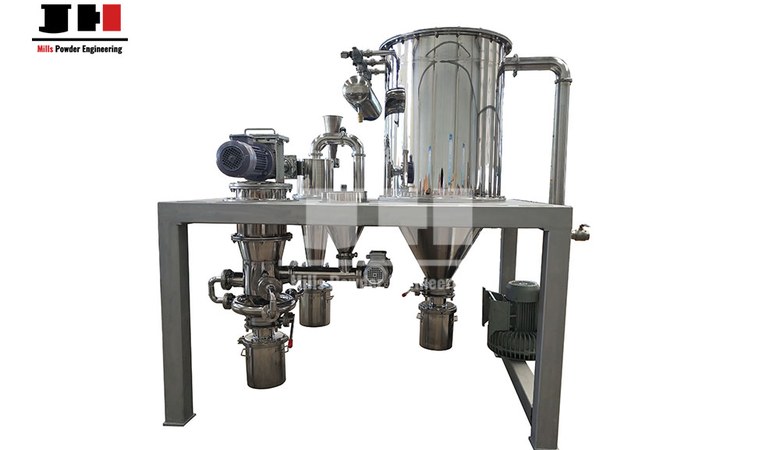
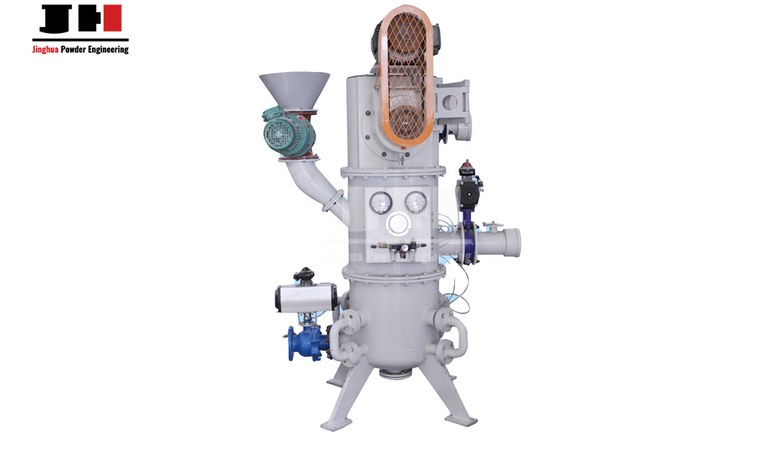
A micronizer is not only a chamber that makes powder smaller. In a real project, it is a system decision. The grinding chamber, nozzles, classifier or separation method, feeding method, dust collector, collection vessel, control cabinet, air compressor, and optional inert-gas loop all affect the final result.
For a buyer, the first question is whether the material can be milled by particle collision under high-velocity air or gas. Brittle minerals, ceramics, battery-related powders, some chemicals, and selected pharmaceutical or food ingredients may be suitable. Sticky, oily, high-moisture, elastic, or heat-softening materials need closer review before a jet mill is recommended.
Mills Powder's core jet mill product page is the right product destination for this decision because it explains the main equipment structure and gives a product-level bridge for buyers comparing air jet mill options. Supporting articles should help the buyer prepare the technical information before they ask for a quote.
Start with Particle-Size Targets, Not Only Micron Words
Many inquiries say only 'we need 5 micron powder' or 'we need ultra-fine powder.' That is not enough for equipment sizing. A production specification should say whether the target is D50, D90, D97, or top cut, and whether the buyer cares more about average size, coarse-particle control, or distribution width.
For example, two powders can both show a similar average particle size while one still contains coarse tails that fail downstream use. A jet mill micronizer selection should therefore connect the fineness target to the measurement method and the pass/fail condition. If the buyer has previous particle-size test reports, those reports should be sent before the supplier proposes a model.
The existing Mills Powder guide on particle size data explains why D10, D50, D90, D97, and distribution width matter before requesting a grinding solution. Review that guide to prepare a complete PSD brief before defining the micronizer specification.
Use Lab Testing to Reduce Production Risk
A lab scale jet mill is useful when the material is new, expensive, sensitive, or commercially important. The test does not need to prove every production detail, but it can show whether the material fractures as expected, whether the fine fraction is collectible, whether feeding is stable, and whether heat or contamination risks need extra controls.
For R&D teams, the lab test should record feed size, sample quantity, target PSD, air pressure or gas conditions, collection yield, abnormal sticking or caking, visible wear risk, and any cleaning concern. For procurement teams, the same data helps define the quotation boundary: what is included in the system, what utilities are required, and what assumptions are still open.
Mills Powder also provides a laboratory jet mill guide for this stage. Use that guide to understand testing options, while this page focuses on how lab data becomes a production specification.
Specification Matrix for a Jet Mill Micronizer Inquiry
The following matrix is a practical way to move from an early inquiry to a quotation-ready specification.
| Decision item | What to provide | Why it matters |
|---|---|---|
| Material and feed size | Material name, feed PSD, bulk density, moisture, and any agglomeration behavior. | Determines whether jet milling is suitable and how feeding should be designed. |
| Target PSD | D50, D90, D97, top cut, measurement method, and pass/fail tolerance. | Prevents confusion between average size and coarse-particle control. |
| Lab test data | Sample quantity, test conditions, PSD result, yield, sticking, heat, and cleaning notes. | Turns early feasibility into a production specification. |
| System boundary | Mill, classifier, feeder, collector, controls, compressor, inert gas, or closed-loop needs. | Keeps quotations comparable across suppliers. |
| Commercial requirement | Capacity target, batch/continuous operation, installation site, and required documents. | Connects engineering design to procurement and project planning. |
When a Jet Mill May Not Be the Right First Choice
A jet mill is strong for ultra-fine grinding when the material can be accelerated, fractured, and classified efficiently. It is not automatically the best first choice for every powder. If the target size is moderate, the capacity requirement is high, the material is very abrasive, or compressed-air cost is a major limitation, an impact mill, air classifying mill, roller mill, or combined grinding and classifying system may deserve comparison.
The decision should also consider whether the buyer's main problem is grinding or classification. Sometimes the milling step is already acceptable, but the final powder still has too many coarse particles. In that case, a standalone classifier or a stronger classifying section may solve the issue more directly than changing the entire micronizer.
How to Discuss Capacity Without Creating False Certainty
Capacity is usually the number buyers want most, but it is also one of the easiest numbers to misunderstand. A jet mill system's capacity depends on material hardness, feed size, target PSD, bulk density, moisture, collection efficiency, airflow, pressure, and the accepted amount of coarse return or reject. Without testing or similar material history, capacity should be treated as an engineering estimate, not a guaranteed number.
A useful supplier conversation separates confirmed data from assumptions. Confirmed data may include feed size, test PSD, material name, and utility conditions. Assumptions may include production continuity, collection yield, operator schedule, and acceptable adjustment range. This is why a quotation should list the system boundary and utilities clearly instead of only showing one equipment model name.
For procurement comparison, connect this topic to the jet mill quotation guide so buyers compare scope, utilities, testing, wear parts, and commissioning assumptions rather than only one model name.
Where to Go Next: Product Details, Testing, or Quotation Review?
For equipment design and operating principles, review the core Mills Powder jet mill product page. If you are comparing suppliers or preparing a purchase, continue with the quotation guide. If you are still checking material feasibility, start with the laboratory jet mill guide.
A practical evaluation sequence is clear: confirm product fit on the core Jet Mill page, review lab testing, prepare the particle-size data, and then compare quotation scope. This keeps testing, specification, and procurement decisions connected.
FAQ
Is a jet mill micronizer the same as an air jet mill? In many buyer conversations, the terms overlap. A micronizer usually emphasizes ultra-fine particle-size reduction, while air jet mill emphasizes the high-velocity air or gas grinding principle. The final equipment choice still depends on material behavior and PSD target.
Can a lab test predict production capacity exactly? No. A lab test reduces uncertainty, but production capacity must still account for scale, airflow, feeding stability, collection design, and operating conditions.
What information should I send before asking for a quotation? Send material name, feed size, target D50/D90/D97 or top cut, sample test data if available, required capacity, moisture, heat sensitivity, contamination limit, available utilities, and cleaning requirements.
Where can I review Mills Powder Jet Mill equipment? Start with the core jet mill product page for equipment details, then use the laboratory and quotation guides for testing and procurement planning.
Engineering Summary
A good jet mill micronizer specification starts from testable material data, not from a model name. Define the target PSD, confirm whether the material is suitable for jet milling, use lab testing when the risk is high, and separate the grinding chamber from the full system boundary. For a Mills Powder inquiry, send the material, feed size, target particle-size report, capacity expectation, utility conditions, and cleaning or contamination limits so the technical team can recommend a realistic configuration.
Conclusion
If you are comparing jet mill micronizer options, start with your particle-size target and material behavior, then ask the supplier to explain the testing route and production system boundary. Mills Powder can review sample data, discuss lab testing, and prepare a configuration direction for a production jet mill system. To begin, send your material, target PSD, capacity requirement, and process notes through the Mills Powder contact page.
For equipment details, start with the Mills Powder jet mill product page, then use the laboratory jet mill guide and particle size data guide when you need testing and PSD preparation before a quote.