
Introduction
Many powder processing buyers ask for a machine recommendation after giving only a material name and a target micron size. In real production, that is rarely enough. A powder may look simple in a datasheet but behave very differently during feeding, grinding, classification, collection and cleaning.
Powder sample testing is the step that connects a buyer's target to a workable process route. It helps confirm whether the material can reach the required particle size distribution, whether the result is stable enough for scale-up, and what equipment boundary should be included in a quotation.
For Mills Powder, sample testing is a practical engineering check before selecting a jet mill system, an air classifier, an impact mill, or a complete grinding and classification line.
Quick Answer
- Powder sample testing should confirm the feed condition, target D50 D90 D97 or top cut, achievable product quality, collection behavior, and scale-up assumptions before a buyer approves equipment selection.
- A useful test request includes material name, application, feed size, target PSD, moisture, bulk density, heat sensitivity, contamination limits, required capacity and any factory constraints.
- Lab results can guide system selection and preliminary capacity direction, but they should not be treated as a full production guarantee without scale-up review.
- Testing is especially important when the powder is abrasive, sticky, heat-sensitive, quality-critical, very light, difficult to collect, or expected to meet a narrow D97 or top-cut requirement.
Why Sample Testing Matters Before Equipment Selection
Equipment catalogs can describe working principles, model ranges and typical applications. They cannot fully predict how a specific powder will feed, break, classify, recover or clean in a real system. This is why a buyer should not choose a model only from a particle-size target such as 5 microns or 10 microns.
During testing, engineers check whether the powder feeds consistently, breaks efficiently, leaves coarse particles after classification, sticks to the collection system, or needs special cleaning. The test also helps define the quotation boundary, because tight top-cut control, cooling, ceramic contact parts or extra collection scope can change the whole system.
What Buyers Should Prepare Before a Powder Sample Test
A sample test becomes more useful when the supplier receives the right information before the test starts. The most important input is not only the powder sample. It is the process target behind the sample.
Prepare the material name, application, feed size range, current process if there is one, target D50 D90 D97 or mesh, required capacity, moisture level, bulk density, temperature sensitivity, contamination limits and safety notes. If a particle-size report already exists, send the full curve rather than only the average size.
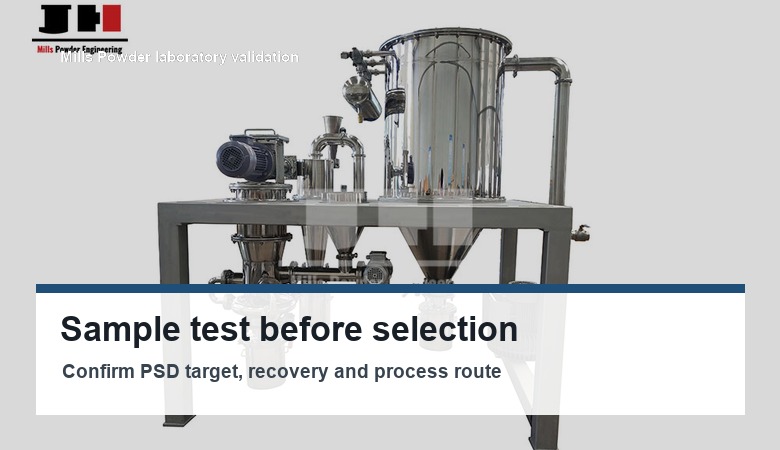
Buyers should also explain the commercial purpose of the test. A research batch, a pilot line, a production upgrade and a new factory quotation all need different assumptions. Mills Powder's laboratory equipment is useful for this early validation stage because it supports controlled review before committing to a production configuration.
A Practical Sample Testing Workflow
A well-run sample test usually follows a simple sequence. First, the buyer and supplier confirm the target: not only the final micron number, but the required distribution, collection method and acceptance basis. Second, the supplier checks the material condition, including feed size, moisture, flowability and any handling risk.
Third, the lab team runs initial parameters and records the direction of the result. For jet milling, this may include feed rate, grinding pressure, classifier speed and collection behavior. For impact milling or classification, it may include rotor speed, airflow, classifier wheel setting and product recovery. Finally, the supplier translates the result into a production discussion instead of copying lab settings directly into a commercial model.
How Lab Data Should Be Used for Scale-Up
Lab testing can reduce selection risk, but it cannot remove every production assumption. Production lines have different residence time, feed stability, air volume, collection area, temperature behavior and operator adjustments. A responsible test report should separate what was observed from what is still an engineering estimate.
For example, a lab test may confirm that the powder can reach the target D97 under certain settings. It may also show collection, flowability or dust-control limits that should enter the quotation. This is the same logic behind using lab data to turn lab test data into a production specification: the value is the decision framework, not only the result sheet.
Sample Test Inputs and Outputs Buyers Should Compare
| What to define | Why it matters | What the test can show |
|---|---|---|
| Feed size and material condition | Large particles, moisture or agglomeration can change feeding and grinding behavior. | Whether preparation, drying or pre-crushing may be needed. |
| Target D50 D90 D97 or top cut | Average micron size alone does not control the coarse tail. | Whether the selected mill and classifier route can reach the required PSD. |
| Capacity goal and production scale | Lab throughput is not the same as production capacity. | A scale-up direction and the assumptions that still need engineering review. |
| Heat and contamination limits | Heat-sensitive or contamination-sensitive powders may need special contact parts or process conditions. | Whether the selected route creates temperature, wear or cleaning concerns. |
| Collection and recovery behavior | Very fine or light powders may stick, leak or recover poorly if the system boundary is incomplete. | Whether collector, filter, fan and cleaning scope need special attention. |
When Sample Testing Is Most Important
Sample testing is most important when the powder has high process uncertainty. Abrasive minerals, ceramic powders, pharmaceutical intermediates, food additives, battery materials, pigments and high-value chemicals can all create hidden risks if selection is based only on a material name.
Testing is also important when the acceptance target is strict. If the buyer needs a narrow D97, low coarse-particle content, limited heat rise, low contamination risk, good product recovery or consistent batch-to-batch quality, the system should be validated before the quotation is treated as final.
Testing may be less critical for a repeat material where the buyer has stable production history and the supplier has directly comparable evidence. Even then, the quotation should state the assumptions clearly so later commissioning does not become a dispute about what was promised.
Common Mistakes to Avoid
The first mistake is sending only a small, unrepresentative sample. A clean top-layer sample may not show moisture variation, agglomeration, coarse lumps or foreign particles that appear in real production. The second mistake is asking for only one particle-size number. D50 alone does not explain the coarse tail, and the coarse tail is often where quality complaints appear.
The next mistake is treating lab capacity as production capacity. A lab test can point toward capacity direction, but production capacity depends on feeding, air volume, collection, heat, wear and system stability. Buyers should also compare quotations by test basis and system boundary, not only by the main mill model.
What to Send Mills Powder for Review
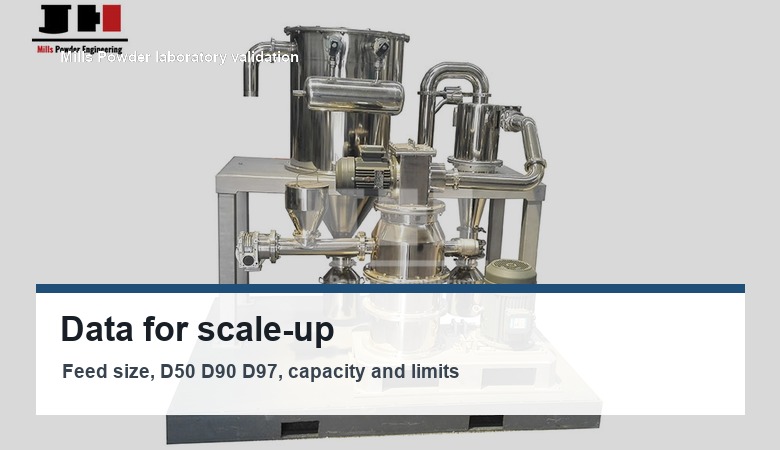
For a practical review, prepare the material name, application, current feed size, target D50 D90 D97 or mesh, required capacity, moisture, bulk density, heat sensitivity, contamination limits, sample quantity and expected production scale. If the material is hazardous, explosive, solvent-bearing, food-grade or pharmaceutical, include handling and cleaning requirements at the start.
If you already have lab reports, send the complete particle-size curve and test conditions. If not, explain the final product use and quality problem. To start the discussion, send Mills Powder your sample testing requirements with the basic process data.
FAQ
How much sample is needed for powder testing?
The required amount depends on the material, target particle size and test purpose. A screening test may need less sample than a repeatability or scale-up test. The supplier should confirm sample quantity after reviewing the target and process risk.
Can lab testing guarantee production capacity?
Lab testing can guide production selection, but it should not be described as an unconditional guarantee. Production capacity depends on feeding, air volume, classifier setting, collection, heat behavior, material variation and system layout.
Is D50 enough for a sample test request?
Usually no. D50 is useful, but D90, D97 or top cut often matters more for quality-sensitive powders. A full particle-size distribution helps the supplier judge coarse-particle control and classification requirements.
Should I test before comparing supplier quotations?
Testing is recommended when the material is new, difficult, high-value or quality-critical. It helps buyers compare quotations based on real process assumptions instead of only model names and motor power.
What if I do not know the target PSD yet?
Explain the application, current product problem and downstream quality requirement. The supplier can help define a practical test target, but final acceptance should still be written clearly before ordering.
Engineering Summary
- Powder sample testing connects material behavior, particle-size targets and equipment selection before a buyer approves a production quotation.
- A good test request defines feed size, target D50 D90 D97 or top cut, moisture, capacity goal, contamination limits and production assumptions.
- Lab results should be used as engineering evidence for scale-up, not as unsupported promises about full production performance.
- Testing is most valuable when powder behavior, quality acceptance or system scope is uncertain.
Conclusion
Powder sample testing is one of the most useful steps before selecting a grinding or classification system. It gives both the buyer and the supplier a shared basis for discussing equipment type, system boundary, scale-up assumptions and final acceptance.
If you are preparing a new powder project, send Mills Powder your material name, feed size, target D50 D90 D97, required capacity, application, sample quantity and factory conditions. Our team can review the information and recommend a practical testing and equipment selection path.