
Introduction
Many buyers search for a pharmaceutical jet mill when they need fine micronization for active ingredients, excipients, medical powders, nutraceutical ingredients, or other quality-sensitive materials. In real production, the first question is not only whether a jet mill can make a small particle size. The safer question is whether the whole system can meet the required particle size distribution, temperature limit, contamination requirement, cleaning expectation, containment need, and acceptance method.
Based on old baseline search evidence from 2025-07-06 to 2026-07-18, medical and pharmaceutical jet mill queries showed meaningful paid-search demand for Mills Powder. This article therefore focuses on the engineering checklist a buyer should confirm before requesting a final quotation. It does not claim GMP certification, validated drug-process performance, or a guaranteed micron size; those conclusions require project-specific evidence and approval conditions.
Quick Answer
- Choose a pharmaceutical jet mill route only after defining D50, D90, D97 or top-cut targets, not only an average micron size.
- Check heat sensitivity, contamination limits, cleaning access, material contact parts, containment expectations and dust collection together.
- Use a lab or pilot test when PSD, yield, buildup, temperature behavior or scale-up risk is quality-critical.
- A reliable quotation should separate confirmed test results from assumptions about capacity, air consumption, collection and utilities.
- For organic SEO routing, pharmaceutical jet mill intent should support the core Jet Mill page rather than splitting authority to overlapping long URLs.
What a Pharmaceutical Jet Mill Must Confirm
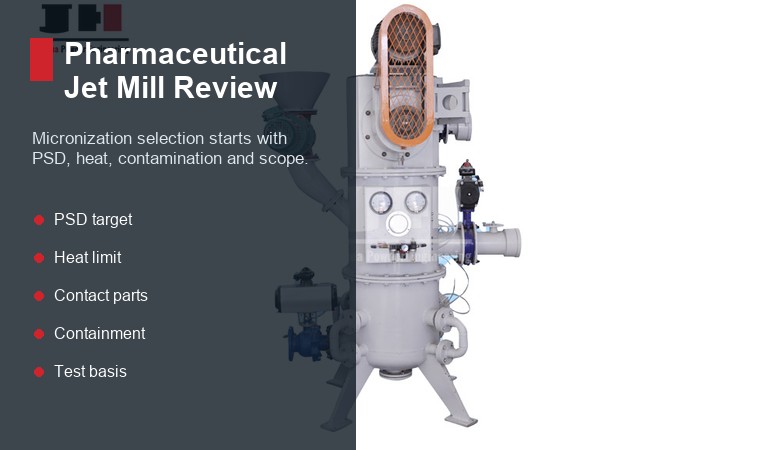
A jet mill uses high-speed gas to accelerate particles so that particle-to-particle impact reduces size. Because the grinding force is created by airflow rather than a mechanical hammer or pin, jet milling is often evaluated when buyers want fine PSD control, reduced mechanical grinding contact, and lower heat generation compared with some mechanical milling routes. Buyers can review the Mills Powder pharmaceutical jet mill product page for the main equipment route.
For pharmaceutical-style projects, however, the mill body is only one part of the decision. The supplier and buyer should define the feeder, grinding chamber, classifier or classification zone, cyclone, filter, fan or compressed-air assumptions, control cabinet, discharge method, cleaning access, contact materials, and documentation expectations. If the quotation only lists a model name, the buyer may not know what process boundary is being priced.
The same material name can behave differently by source, moisture, crystal form, feed-size range, electrostatic tendency, and temperature sensitivity. This is why Mills Powder normally asks for material information and, where needed, a representative test before confirming a final jet milling configuration.
Why PSD Targets Matter More Than a Single Micron Number
A request such as "make it 5 microns" is not enough for engineering selection. A supplier needs to know whether the buyer means D50, D90, D97, top cut, sieve residue, or another acceptance method. Two powders with the same D50 can have very different coarse tails, and the coarse tail is often where downstream performance complaints appear.
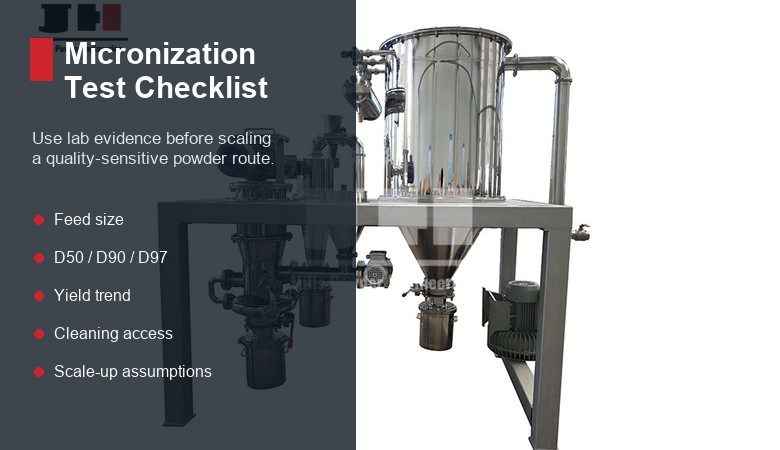
For micronization projects, the buyer should provide the current feed PSD, target PSD, allowed oversize level, test method, application need, and acceptable tolerance. If the buyer has no full report yet, a small-scale test through Mills Powder laboratory equipment can help define whether the target is realistic before production quotation. The previous jet mill micronizer selection article also explains how lab data can become a production specification.
Selection Table for Pharmaceutical Micronization Projects
| Decision item | What to confirm | Why it matters in production |
|---|---|---|
| PSD target | D50, D90, D97, top cut, test method and tolerance | Avoids quoting against an unclear micron claim |
| Material behavior | Moisture, flowability, stickiness, heat sensitivity, abrasiveness and electrostatic tendency | Affects feeding, buildup, heat behavior, wear and collection |
| Contamination limit | Contact materials, lining, seals, cleaning access and cross-contamination risk | Defines whether the system can match quality expectations |
| Containment and dust handling | Collection, discharge, filter, safe handling and cleaning process | Changes the real system scope and operator workflow |
| Scale-up basis | Lab test result, assumed feed rate, gas pressure, classifier setting and collection behavior | Separates confirmed evidence from engineering assumptions |
| Quotation boundary | Feeder, mill, classifier, cyclone, filter, controls, utilities, installation and spare parts | Prevents misleading price comparison between incomplete scopes |
Heat, Contamination and Containment Questions
Pharmaceutical and medical-powder projects often involve heat-sensitive, expensive, or contamination-sensitive materials. Jet milling may help because the compressed gas expands during grinding and can reduce direct mechanical grinding contact. That does not remove the need to review temperature rise, material contact surfaces, seals, discharge, filters, cleaning method, and cross-contamination risk.
If the powder is very heat-sensitive, compare the project with Mills Powder's guide to an air jet mill for heat-sensitive powders. If the main concern is metal pickup or cross-contamination, the buyer should also review contamination control in jet milling and define acceptable limits before selecting lining, contact materials, or cleaning procedures.
Containment should be discussed early. Some materials require attention to dust exposure, safe handling, collection, discharge, and operator cleaning steps. Without clear containment expectations, two suppliers may quote very different systems while using the same phrase "pharmaceutical jet mill."
What to Send Before Requesting a Quotation
A quotation request should include material name, application, feed size, feed PSD, target D50/D90/D97 or top cut, required capacity, batch size or continuous operation need, moisture, bulk density, heat limit, contamination limit, cleaning expectation, containment expectation, available compressed air or nitrogen, and site utilities.
The buyer should also state whether the quotation must include testing, installation support, commissioning, operator training, spare parts, documentation, and packaging interface. A low quote that excludes feeder, collection, controls, or utilities may become more expensive once the production boundary is fully defined.
When the buyer is still comparing process routes, the initial step can be a technical discussion rather than a final purchase specification. The project team can contact Mills Powder with material data and target PSD so the first review can separate likely jet milling fit from cases that need a different grinding or classification route.
Project Experience
In project discussions, buyers often focus first on whether the machine can reach a named micron size. After material review, the more important issue is usually the acceptance basis: whether the target is D50 or D97, how much coarse tail is allowed, whether the powder heats up, whether collection reduces yield, and whether cleaning or containment changes the system scope. This is why sample testing and a written scope are more useful than comparing model names alone.
FAQ
Is a pharmaceutical jet mill different from a standard jet mill?
The core grinding principle may be similar, but the project review is stricter. Buyers should confirm material contact parts, cleaning access, containment needs, temperature limits, contamination control, documentation expectations and sample-test acceptance before choosing a configuration.
Can a jet mill guarantee a target micron size before testing?
No supplier should treat a micron target as guaranteed before representative testing or clear process assumptions. PSD depends on feed size, material properties, air pressure, feed rate, classifier setting, collection behavior and the acceptance method used by the buyer.
When is a lab jet mill test useful?
A lab test is useful when the buyer needs to confirm achievable D50, D90, D97, heat behavior, yield, possible buildup and scale-up direction before committing to production equipment. It cannot replace full production validation, but it reduces early selection risk.
What should be included in a pharmaceutical jet mill quotation?
A useful quotation should define the mill, classifier or collection scope, feeder, cyclone, filter, fan or compressed-air assumptions, controls, contact material, cleaning access, spare parts, utilities, testing basis and excluded items.
Does jet milling solve every pharmaceutical powder problem?
No. Jet milling is often evaluated for fine micronization, lower mechanical grinding contact and heat-sensitive powders, but it may not fit sticky, high-moisture, low-flowability or unsuitable safety-risk materials without additional process review.
Engineering Summary
- Pharmaceutical jet mill selection should begin with PSD target, material behavior, heat limit, contamination requirement, containment expectation and acceptance method.
- A jet mill can be a strong micronization route, but it cannot guarantee every target before material testing or clearly stated process assumptions.
- The quotation should define the full process boundary, including feeding, milling, classification, collection, controls, utilities, cleaning access and excluded items.
- For Mills Powder organic routing, this topic should support the core Jet Mill product page and use laboratory testing and contact pages as supporting conversion paths.
Conclusion
A pharmaceutical jet mill is selected through process confirmation, not through a model name alone. Start with the material, feed condition, target PSD, heat and contamination limits, containment expectations, and acceptance method. Then use testing or engineering review to decide whether the jet mill route is suitable and what system scope should be quoted.
If you are evaluating micronization for a pharmaceutical, medical, nutraceutical, or other quality-sensitive powder, contact Mills Powder with your material name, feed size, target D50/D90/D97, required capacity, temperature limit, contamination limit, and site conditions. The team can review whether jet milling, testing, or another powder-processing route should be evaluated first.