
Air Jet Mill for Heat-Sensitive Powders: What to Confirm Before Production
Introduction
Many buyers search for an air jet mill because the material cannot tolerate high mechanical heat, heavy metal contact, or broad particle size distribution. In real production, the question is not simply whether jet milling can make a fine powder. The better question is whether the material can reach the required D50, D90, D97, capacity, and quality limit under controlled air, feeding, and classification conditions.
An air jet mill can be a strong fit for heat-sensitive powders because particle size reduction is driven mainly by high-speed particle-to-particle collision rather than a hot mechanical grinding surface. But it is not a universal shortcut. Feed stability, moisture, agglomeration, compressed air conditions, classifier settings, and downstream collection all affect the final result.
This article explains what to confirm before using an air jet mill for heat-sensitive powder production, how to read laboratory test data, and what information Mills Powder normally needs before recommending a production system configuration.
Quick Answer
- An air jet mill is usually considered when a powder needs ultra-fine milling, narrow PSD control, limited mechanical heat, or lower grinding-part contact.
- Heat-sensitive powders still require testing because moisture, melting point, agglomeration, and feed behavior can limit capacity or stable fineness.
- The key specification is not only micron size; buyers should define D50, D90, D97 or top cut, temperature limits, contamination limits, and required capacity.
- A lab jet mill test can confirm achievable PSD and process direction, but production capacity must be estimated with scale-up assumptions and final system review.
- The best quotation request includes material data, feed size, target PSD, temperature sensitivity, moisture, safety notes, and factory utility conditions.
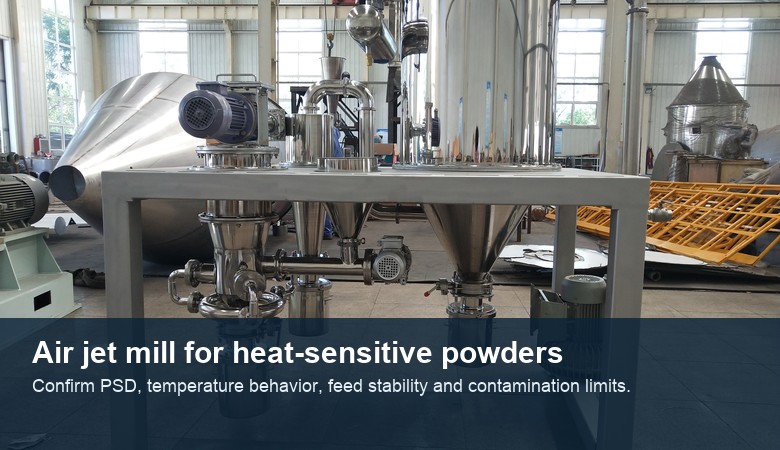
When an Air Jet Mill Fits Heat-Sensitive Powders
Air jet milling is often evaluated for pharmaceuticals, food ingredients, specialty chemicals, battery materials, pigments, cosmetics, and high-value mineral powders. These applications may need fine particle size without excessive temperature rise, or they may need a process route that reduces direct metal-to-powder grinding contact.
In a typical fluidized bed or opposed jet milling process, compressed air accelerates particles so they collide with each other. The classifier then separates fine particles from coarse particles. This makes the mill especially useful when the buyer needs ultra-fine powder and tighter PSD control than a simple mechanical mill can provide.
However, the air jet mill must be evaluated as a system. The feeder must keep material entering steadily. The classifier must be matched to the target top cut. The cyclone, bag filter, fan, and controls must maintain stable collection. If the process also needs a separate classification stage, an AF air classifier may be reviewed as part of the overall line rather than treated as an afterthought.
Where Heat Problems Still Come From
Jet milling can reduce mechanical heat input, but it does not remove every heat-related risk. Compressed air condition, recirculation, material residence time, classifier load, and dust collection performance can all influence product temperature and stability.
Some materials soften, smear, or agglomerate when the temperature rises only slightly. Others are affected more by moisture than by temperature. In these cases, a low-temperature process route may still fail if feeding is unstable or if the powder cakes inside the collector.
This is why Mills Powder normally treats heat sensitivity as an engineering condition, not as a marketing label. The buyer should define the maximum acceptable product temperature or known softening behavior, then use material testing to check whether stable grinding and collection are practical.
Specification Factors to Confirm Before Quotation
A useful inquiry should start with process limits rather than only a target model. For heat-sensitive powders, the following items usually change the recommendation:
| Factor | What to Define | Why It Matters in Production |
|---|---|---|
| Material behavior | Heat sensitivity, melting/softening point, stickiness, hygroscopic behavior | Determines whether powder can feed, grind, and collect without caking or smearing. |
| Particle size target | D50, D90, D97 or top cut, not only average micron size | Controls classifier settings, air demand, residence time, and final quality acceptance. |
| Feed condition | Feed size, moisture, bulk density, flowability, agglomerates | Unstable feeding changes grinding load and may create coarse particles or capacity loss. |
| Contamination limit | Material-contact requirements, lining needs, cleaning rules | Affects chamber material, wear protection, collector design, and batch changeover plan. |
| Utilities and layout | Compressed air, power, installation space, dust collection, safety needs | A technically successful test still needs a feasible production system layout. |
How Laboratory Testing Supports Scale-Up
A lab jet mill test is valuable because it shows how the material responds to jet milling before a buyer commits to a production line. The test can reveal whether the powder reaches the target PSD, whether coarse particles remain, whether agglomeration appears, and whether the collected powder is easy to handle.
Lab results should be read carefully. A small test can support the process direction, but it does not automatically guarantee production capacity. Production scale depends on equipment size, air volume, nozzle configuration, classifier design, dust collection, feeding, and factory utilities. The test report should become part of the production specification, not a replacement for it.
For a broader selection process, buyers can also compare the test output with the requirements discussed in jet mill micronizer selection. That helps separate achievable fineness from the full system scope needed for stable industrial operation.
How Test Data Becomes a Production Specification
After a heat-sensitive powder test, the useful result is not only a pass or fail judgment. The result should be translated into a production specification that defines the accepted PSD range, operating window, feeding method, collection route, cleaning requirement, and scale-up assumptions.
For example, if the lab test reaches the target D97 only at a very low feed rate, the quotation should not use an optimistic capacity without explanation. If the product temperature remains acceptable during a short test but the material shows slight buildup, the production design may need stronger feeding control, better air preparation, shorter cleaning intervals, or a different collector arrangement.
The same logic applies to contamination review. If the application has a strict metal or cross-contamination limit, the specification should name the inspection method and material-contact requirement. Without that information, a supplier can only give a general configuration. A clearer specification reduces misunderstanding between R&D, procurement, quality, and the equipment manufacturer.
When an Air Jet Mill May Not Be the Best Choice
Air jet milling may not be the most practical route when the material is very sticky, oily, wet, low-value at high throughput, or only needs a relatively coarse particle size. It may also be less economical when compressed air supply is limited or when the target capacity is high but the quality requirement does not justify jet milling.
If the powder only needs medium-fine grinding and has good heat tolerance, an impact mill or air classifying impact mill may be more cost-effective. If the main issue is removing coarse particles from an already-ground powder, independent air classification may be enough. If the buyer is unsure, material testing and a system comparison are safer than choosing a machine name first.
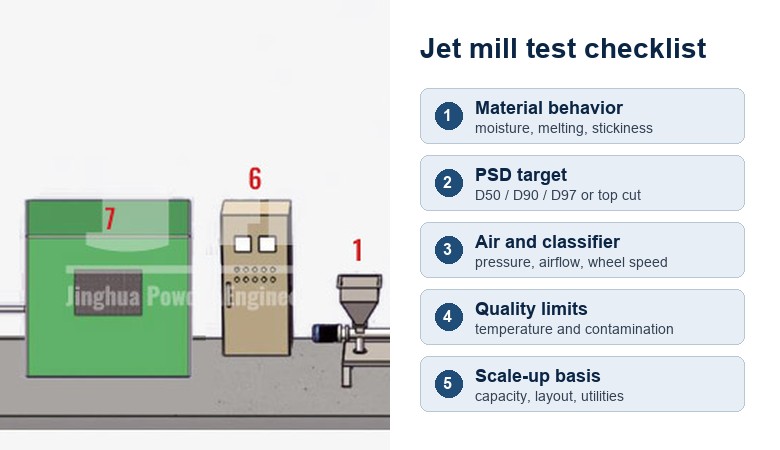
Practical Scale-Up Checklist
Before approving a production air jet mill configuration, confirm the feed material, process limit, testing result, and factory condition together. A quotation is more reliable when the buyer provides feed size, target D50/D90/D97, required capacity, moisture, temperature sensitivity, contamination limit, available compressed air, voltage, installation space, collection requirements, and cleaning expectations.
For a project discussion, contact Mills Powder with the material name, sample status, target PSD report, capacity target, application, and any temperature or contamination restriction. Mills Powder can then review whether a jet mill system, laboratory test, air classification stage, or another grinding route should be evaluated first.
FAQ
Is an air jet mill always better for heat-sensitive powders?
No. It can reduce mechanical heat input, but the final result still depends on material behavior, air conditions, classifier load, moisture, feeding, and collection. Testing is needed before treating it as the final route.
What particle size data should I provide?
Provide target D50, D90, D97 or top cut, plus any acceptable tolerance. A single average micron value is usually not enough for selecting a jet mill and classifier configuration.
Can a lab jet mill test guarantee production capacity?
A lab test can confirm feasibility and process direction, but it does not guarantee industrial capacity by itself. Production capacity depends on scale-up assumptions, air volume, classifier design, feeding stability, and collection efficiency.
How do I reduce contamination risk in jet milling?
Define the contamination limit first, then review material-contact parts, lining options, cleaning procedure, air quality, dust collection, and batch changeover requirements. Avoid unsupported purity claims unless test conditions and inspection methods are available.
When should I add a separate air classifier?
A separate classifier may be useful when the process needs tighter top-cut control, multiple final particle size grades, or an upgrade to an existing grinding route. The need should be confirmed from the PSD target and process layout.
Key Takeaways
- Air jet milling is a strong candidate for fine, heat-sensitive powders when PSD control and low mechanical grinding contact are important.
- Heat-sensitive materials still need controlled testing because moisture, stickiness, and agglomeration can limit stable operation.
- A quotation-ready specification should include target D50/D90/D97, temperature limits, contamination limits, feed condition, capacity, and factory utilities.
- Lab testing supports scale-up decisions, but final production capacity requires system-level engineering review.
Conclusion
Heat-sensitive powder projects should be specified with testable limits, not broad claims. If you are evaluating an air jet mill, send Mills Powder your material name, feed size, target D50/D90/D97, required capacity, moisture condition, temperature sensitivity, contamination limit, application, and factory layout condition. The team can review whether a jet mill, lab test, classification stage, or another system route should be evaluated first.