
An air classification system quotation can look precise while still leaving the most important engineering questions unanswered. A model name and motor power do not define whether the system can hold the required cut point, handle the real feed condition, recover fine product, or fit the buyer’s utilities. Before comparing suppliers, the buyer needs a written specification that connects particle-size targets with feed rate, airflow, classifier-wheel operation, collection, controls, and test evidence.
This guide explains what to define before requesting an air classification system quotation. It is intended for process engineers, plant teams, and technical procurement staff who need a comparable scope rather than a list of unrelated machine prices.
Quick Answer
- Define the target with a full particle-size distribution, not only one micron or mesh value.
- State the feed material, feed-size range, moisture, bulk density, temperature, and flow behavior.
- Separate feed rate from qualified product rate; oversize recycle and collection losses can change the balance.
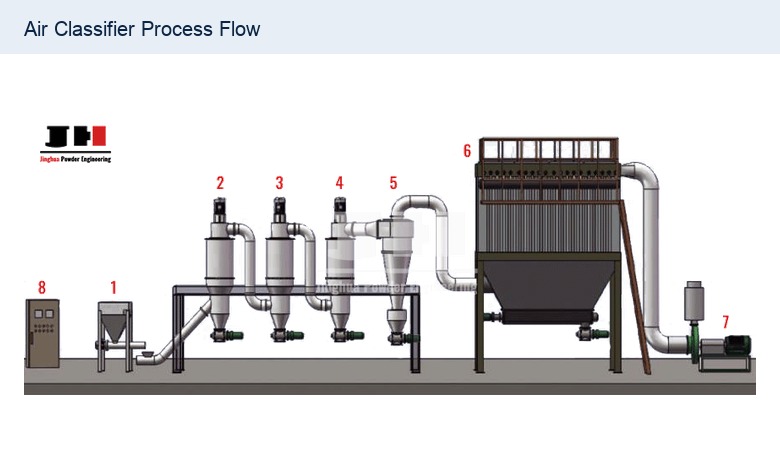
- Ask the supplier to state the complete boundary: feeder, classifier, fan, cyclone or filter, valves, controls, and optional protection items.
- Use representative testing when the material is new, difficult, abrasive, sticky, heat sensitive, or purity sensitive.
Why the System Boundary Matters
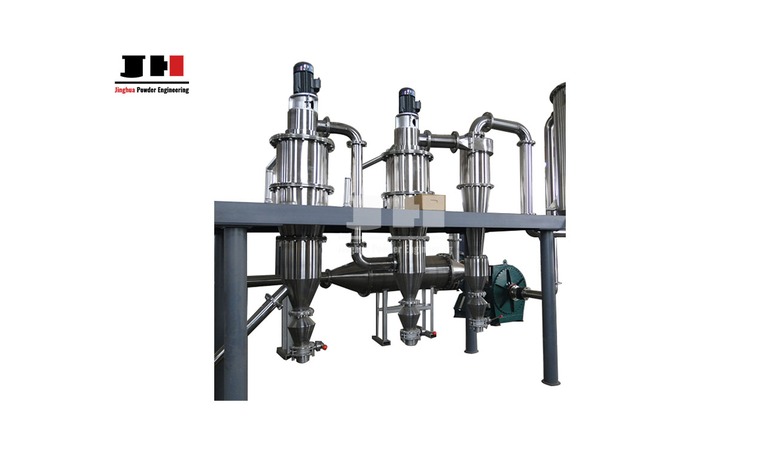
An air classifier does not work in isolation. Feed enters a controlled air stream, particles are separated by the balance of aerodynamic and centrifugal forces, coarse material leaves through one route, and fine product travels to a collection stage. Stable results depend on how these parts interact. A suitable classifier connected to an undersized fan or poorly matched filter can still produce unstable flow, low recovery, or inconsistent product.
Buyers who need the operating principle first can review how an air classifier works in powder processing. For quotation work, the next step is to turn that principle into a defined process boundary with measurable inputs, outputs, and acceptance criteria.
Air Classification System Specification Table
| Specification item | What the buyer should provide | What the supplier should confirm |
|---|---|---|
| Material and feed | Material name, composition, feed-size range, moisture, bulk density, temperature, and flow behavior | Feeding method, contact materials, pre-treatment assumptions, and any material limits |
| Product PSD | Target D50/D90/D97 or top cut, allowed oversize, and test method | Expected adjustment range, sampling method, and conditions used for acceptance |
| Rate and yield | Required feed rate, qualified product rate, operating hours, and batch or continuous duty | Mass-balance assumptions, coarse stream handling, recycle boundary, and estimated recovery basis |
| Air and utilities | Available power, compressed air if used, ambient conditions, and site constraints | Process airflow, fan duty, pressure basis, connected load, and utility interfaces |
| Collection | Dust behavior, product value, packaging route, and emission or housekeeping requirements | Cyclone/filter arrangement, discharge valves, cleaning approach, and fine-product recovery path |
| Controls and safety | Area classification, monitoring needs, interlocks, and site safety requirements | Control scope, instruments, alarms, grounding, and protection options subject to project review |
1. Define Cut Point and PSD Acceptance
The phrase “make it 10 microns” is not a complete classification target. Ten microns could refer to an average size, a D50 value, a D90 limit, a D97 limit, or a top cut. Each describes a different product distribution and can lead to a different classifier setting, airflow requirement, yield, and capacity. The inquiry should name the PSD statistic, the allowed tolerance, and the measurement method.
If oversize particles create a downstream defect, state that risk directly. A narrow distribution or strict top cut may be more important than the nominal average size. The buyer should also confirm whether the acceptance sample is taken from the fine-product outlet, a blended batch, or another defined point. The air classifier design principles guide provides additional context on the variables that influence classification efficiency.
2. Separate Feed Rate from Qualified Product Rate
A classifier may receive one feed rate but deliver a lower rate of product that meets the fine specification. The difference can leave as a coarse fraction, return through a recycle loop, remain in the system during startup, or be lost during collection and cleaning. Quotations should therefore identify both the dry feed rate and the qualified fine-product rate, together with the assumed product split.
Do not compare capacity figures unless the feed PSD, target PSD, material condition, and recovery basis are comparable. A supplier may need test work before confirming a rate. That is an evidence boundary, not a weakness: an untested capacity promise for an unfamiliar powder is less useful than a conditional estimate tied to a sample result.
3. Connect Classifier Wheel, Airflow, and Pressure
The classifier wheel is an important adjustment point, but wheel speed alone does not determine the result. Air volume, pressure distribution, feed loading, particle density, wheel geometry, and system resistance work together. The quotation should state the design airflow and pressure basis, fan boundary, expected adjustment method, and instruments used to monitor stable operation.
Site conditions also matter. Elevation, ambient temperature, existing ductwork, filter loading, and discharge equipment can change the operating point. Provide the supplier with utility and layout constraints before final sizing, especially when a classifier is being added to an existing mill or collection line.
4. Define Collection, Cleaning, and Changeover
Fine powder is only useful if it can be recovered consistently. The system scope should show whether product is collected by cyclone, filter, or a staged arrangement; how it is discharged; and where dust-laden air goes. High-value powders may justify more attention to recovery, while frequent product changes may make access, drain-down, and cleaning more important than the lowest initial equipment cost.
State purity limits, acceptable contact materials, cleaning method, and cross-contamination risk. Safety requirements must be reviewed for the actual powder and site. A quotation can list grounding, monitoring, inerting, explosion-protection, or other options only after the buyer supplies the relevant hazard information and local compliance requirements.
5. Use Test Data to Close the Evidence Gap
Catalog ranges are useful for orientation, but they do not replace material testing. Representative samples can reveal whether the feed disperses, whether moisture causes buildup, how the coarse and fine fractions split, and whether the target PSD remains stable. The test report should record feed condition, operating settings, sample points, PSD method, yield basis, and any visible handling or wear concerns.
Before sending material, use the particle-size data checklist to prepare the feed and product information. The purpose of testing is not to create a universal guarantee. It is to replace open assumptions with project-specific evidence that can support equipment sizing and acceptance terms.
A Practical RFQ Workflow
- Write the product requirement: PSD statistic, tolerance, qualified product rate, purity, temperature, and moisture limits.
- Describe the feed: composition, PSD, bulk density, moisture, flow behavior, hazard information, and available sample quantity.
- Define the plant boundary: upstream feed source, downstream collection or packaging, utilities, controls, space, and access.
- Request a scope table that marks every component as included, optional, buyer supplied, or pending test confirmation.
- Compare quotations using the same assumptions, then convert accepted test results and exclusions into the final specification.
Common Quotation Mistakes
- Using one micron value without identifying D50, D90, D97, or top cut.
- Treating feed rate as guaranteed fine-product output.
- Comparing classifier models without comparing fan, filter, feeder, and controls scope.
- Ignoring coarse-fraction handling, recycle, product loss, and cleaning time.
- Asking for a final capacity or safety configuration before representative material and site data are available.
FAQ
What is the most important specification for an air classification system?
There is no single isolated specification. Start with the required product PSD and qualified product rate, then define the feed condition, yield basis, collection route, and acceptance method. These values form the minimum connected specification.
Is classifier wheel speed enough to predict particle size?
No. Wheel speed interacts with airflow, pressure, feed loading, particle density, wheel geometry, and system resistance. It should be treated as one controlled variable within the full operating system.
When is material testing necessary before quotation?
Testing is especially important for an unfamiliar powder, a strict top cut, a narrow PSD, difficult flow, moisture sensitivity, high abrasiveness, high purity, or a capacity requirement that cannot be supported by directly comparable evidence.
What should be included in an air classifier system quotation?
The quotation should identify the feeder, classifier, fan, ducts, collection equipment, discharge devices, controls, instruments, contact materials, utilities, exclusions, test assumptions, and optional safety or cleaning items. It should also state which performance points remain conditional.
Summary
A useful air classification system quotation begins with a connected specification. Define the feed, product PSD, qualified product rate, mass-balance basis, airflow and utilities, collection route, controls, cleaning, and evidence status. This makes supplier scopes comparable and exposes the assumptions that still need testing.
Conclusion
Mills Powder can review representative material data, test requirements, and the full system boundary before final configuration. Send the feed PSD, target PSD, rate, material properties, utility conditions, and site constraints through the contact page to begin an engineering discussion. Any final selection should be based on the approved project specification and confirmed evidence.