
Introduction
Many buyers ask for air classifier capacity as if it were one fixed value. In real production, the useful answer depends on the required cut point, feed particle size distribution, material density, moisture, airflow, classifier wheel speed, collection efficiency, and whether the quoted capacity means feed rate or accepted fine-product output.
The same classifier model can be reasonable for one powder and unsuitable for another if the target D97, top cut, yield expectation, or feed condition changes. This is why an AF air classifier quotation should define the separation task, not only the machine size. This article explains how buyers can prepare capacity and sizing information before requesting a final proposal.
Quick Answer
- Air classifier capacity is not only a model-table value; it changes with cut point, feed PSD, material behavior, airflow and recovery requirement.
- A finer cut point usually reduces practical throughput unless the system design, airflow, classifier speed and feed control are matched to the target.
- Feed rate is not the same as final fine-product output; coarse return, product loss, recycle and cleaning time can change the useful production rate.
- Buyers should send feed PSD, target D50/D90/D97 or top cut, required output, material density, moisture and collection expectations before final sizing.
- When the capacity target is critical, sample testing or process review is safer than accepting a capacity claim without conditions.
Why Cut Point Changes Capacity
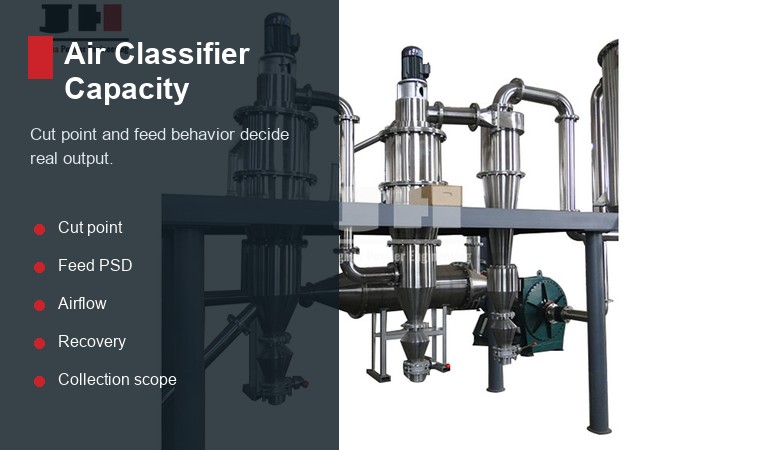
An air classifier separates particles by aerodynamic behavior. Fine particles are carried with the airflow, while coarse particles are rejected by the balance of centrifugal force, drag force, feed load, wheel speed and material behavior. The target cut point decides how tight that balance must be.
When the buyer asks for a coarser product, the classifier may pass more material as acceptable fine product. When the buyer asks for a finer D97 or top cut, the classifier must reject more borderline particles. That usually lowers fine-product output, increases coarse return, or requires a different airflow and wheel-speed condition. The article on why D97 matters explains why this coarse tail matters more than a single average micron value.
Capacity should therefore be written with conditions. A useful statement says what material, feed PSD, target PSD, moisture, airflow condition and collection boundary the estimate assumes. A number without those conditions is only a rough model reference.
Factors That Change Real Air Classifier Output
| Factor | What changes | Capacity effect |
|---|---|---|
| Target cut point | D50, D90, D97 or top cut becomes finer or tighter | Usually lowers accepted fine-product output unless airflow, wheel speed and feed load are matched |
| Feed PSD | More coarse particles or wider distribution enter the classifier | More material may be rejected or recycled, reducing saleable output |
| Material density and shape | Particles classify differently even at similar micron sizes | Changes separation behavior and may require different operating settings |
| Moisture or stickiness | Material agglomerates, builds up or feeds unevenly | Can reduce stable throughput and increase cleaning downtime |
| Airflow and pressure balance | Fan, ducts, filter and system resistance shift the airflow condition | Affects cut point stability, recovery and coarse carryover |
| Collection scope | Cyclone, bag filter, discharge and recycle handling are included or excluded | Changes the real production boundary behind the quoted capacity |
Feed Rate Versus Fine Product Output
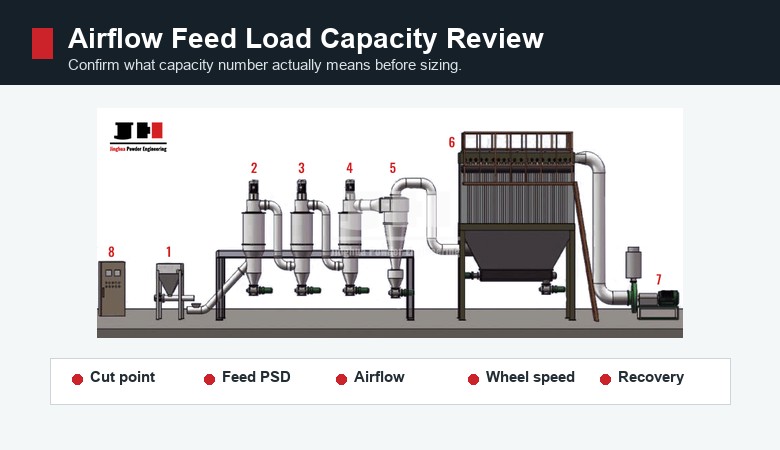
One common quotation mistake is treating feed rate as finished-product capacity. In classification, the material entering the system may split into fine product, coarse reject, recycle stream, dust collector material, startup loss, and cleaning loss. If the accepted fine fraction is only part of the feed, the useful output is lower than the feed rate.
For example, a plant may feed a classifier steadily but still collect less saleable product because the target cut point is tight or the feed contains too much coarse material. Raising feed rate can make this worse if the classifier becomes overloaded. More feed does not automatically create more qualified fine powder.
This is why Mills Powder's air classification system specifications article recommends defining feed condition, accepted product, reject handling, airflow, dust collection and controls before comparing proposals.
How to Prepare Capacity Data Before Quotation
Before asking for final sizing, prepare the material name, application, feed PSD, target D50/D90/D97 or top cut, required fine-product output, acceptable coarse tail, bulk density, moisture, abrasiveness, temperature or safety limits, and whether the process permits recycle.
Also define the operating basis. State whether the line must run continuously, whether capacity is measured before or after classification, whether the buyer accepts multiple passes, and whether the system must include feeder, classifier, cyclone, bag filter, fan, valves, controls, platform and dust handling.
If the project is still in supplier evaluation, the buyer can use the checklist from air classifier manufacturer selection to compare whether each proposal uses the same capacity basis. If one quote includes only a classifier body while another includes a full process line, the apparent price and capacity comparison will be misleading.
When a Larger Classifier Is Not the Right Answer
Capacity problems do not always mean the classifier is too small. The limiting factor may be unstable feeding, too much coarse material in the feed, moisture, agglomeration, poor dispersion, insufficient airflow, weak collection, duct pressure loss, bag filter loading, or a cut point that is too fine for the assumed feed rate.
A larger classifier may help when the target output genuinely requires more air volume, wheel area or rotor capacity. But it will not solve a feed PSD problem, a sticky material problem, or a dust-collection bottleneck by itself. The working-principle article on how an air classifier works is useful for understanding why airflow, wheel speed and feed stability must be reviewed as one system.
In project discussions, Mills Powder usually separates confirmed data from assumptions. If no representative sample or feed PSD is available, capacity should be treated as preliminary. If test data exists, the proposal can state how the test result was interpreted for production scale-up.
Buyer Checklist for Capacity Sizing
- Define whether capacity means feed rate, accepted fine-product output, or total system throughput.
- Send feed PSD and target D50, D90, D97 or top cut, including the test method and tolerance.
- Describe moisture, bulk density, stickiness, abrasiveness, temperature limits and safety notes.
- Confirm whether coarse material will be rejected, recycled, reground, sold as another grade, or discarded.
- Ask whether the quote includes feeder, classifier, cyclone, filter, fan, controls, platform and dust collection.
- Request written assumptions for airflow, classifier speed, collection, yield and operating hours.
FAQ
Why does air classifier capacity change at a finer cut point?
A finer cut point usually needs tighter separation, higher classifier speed, adjusted airflow, and more control of feed load. That can reduce fine-product throughput because more material may report to the coarse fraction or require another pass.
Can a supplier guarantee capacity from a model number alone?
No. A model number is only a starting point. Capacity depends on feed PSD, material density, moisture, stickiness, required D50/D90/D97 or top cut, airflow, collection efficiency, and the accepted product yield.
What particle size data should I send before sizing an air classifier?
Send the feed PSD, target PSD, allowed coarse tail, test method, target capacity, material density, moisture, temperature or safety limits, and whether the process allows recycle or multiple passes.
Is feed rate the same as final fine-product output?
No. Feed rate is the material entering the classifier. Final fine-product output depends on how much material meets the target cut point and how much is rejected, recycled, lost in collection, or held during cleaning and changeover.
When should sample testing be used before final sizing?
Testing is useful when the material is abrasive, sticky, light, moisture-sensitive, high value, or quality-critical, or when the buyer needs a narrow D97 or top cut before approving a production quotation.
Engineering Summary
- Air classifier capacity should be tied to a defined cut point, feed PSD, material behavior, airflow condition and fine-product acceptance method.
- A finer D97 or top cut often reduces practical throughput because more material must be rejected, recycled or processed under tighter airflow and wheel-speed conditions.
- Feed rate, system throughput and saleable fine-product output are different capacity measures and should not be mixed in a quotation.
- Reliable sizing requires process data, and high-risk materials should be tested before final capacity and model selection.
Conclusion
Air classifier sizing is an engineering decision. The buyer should not accept a capacity number unless the supplier also states the cut point, feed PSD, material behavior, airflow assumptions, collection boundary and fine-product basis behind it.
If you are planning a classification project, contact Mills Powder with your material name, feed size, feed PSD, target D50/D90/D97 or top cut, required fine-product output, moisture, bulk density and factory conditions. The team can review whether an air classifier, a grinding and classification line, or a sample test should come first.