
Introduction
Many powder buyers ask a supplier a simple question: “Can your machine make 10 microns?” It sounds like a clear target, but in real production, a single micron number can be misleading. Two powders can both have an average particle size around 10 microns while performing very differently in coating, battery materials, food powders, minerals, chemicals, or pharmaceutical applications.
The reason is particle size distribution. Average particle size, usually expressed as D50, only tells part of the story. D97 shows whether the final powder still contains too many coarse particles. In many projects, D97 has a stronger effect on product quality than the average size alone.
This article explains what D97 means, why it matters more than a general “micron size” claim, and how grinding and classification systems can help control coarse particles in powder processing.
Quick Answer
- D50 describes the average particle size, but it does not show the full coarse particle tail.
- D97 means 97% of particles are smaller than a stated size, making it useful for evaluating coarse particle control.
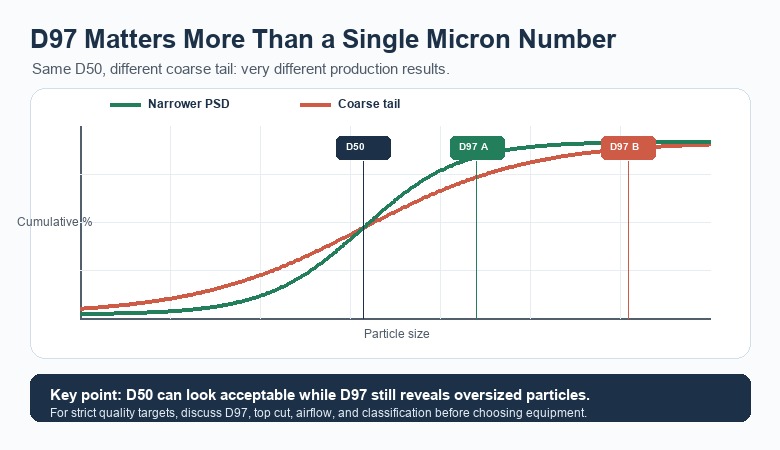
- Two powders with the same D50 can have very different D97 values and perform differently in real production.
- Strict D97 requirements often require stable grinding, airflow, feed rate, and air classification control.
- Material testing is recommended when D97, top cut, or final product consistency is important.
What Does D97 Mean?
D97 is a particle size distribution value. It means that 97% of the powder particles are smaller than the stated size. For example, if a powder has D97 = 20 microns, then 97% of the particles are smaller than 20 microns, while around 3% may be larger.
D50, by comparison, means that 50% of particles are smaller than the stated size. D90 means that 90% are smaller. These values are all useful, but they answer different questions. D50 helps describe the middle of the distribution, while D97 helps describe the coarse end of the distribution.
For many fine powder applications, the coarse end is where problems appear. A small amount of oversized particles can create defects, poor dispersion, unstable downstream processing, or customer complaints.
D50 vs D90 vs D97
| Value | Meaning | What it helps evaluate |
| D50 | 50% of particles are smaller than this size | Average particle size reference |
| D90 | 90% of particles are smaller than this size | Distribution width and upper particle range |
| D97 | 97% of particles are smaller than this size | Coarse particle control and top-end quality risk |
| Top cut | Maximum acceptable particle size | Strict quality limit for oversized particles |
The key point is simple: D50 can look acceptable while D97 is still too coarse. This is why a complete particle size data report is more useful than a single micron target when requesting a grinding solution.
Why D97 Affects Product Performance
In real production, oversized particles often cause the most visible problems. In powder coatings, coarse particles can affect surface smoothness and film appearance. In battery materials, distribution stability can affect mixing, coating uniformity, and downstream processing. In food and nutraceutical powders, coarse particles may affect mouthfeel, solubility, or blending behavior.
For non-metallic minerals, ceramics, pigments, and chemical powders, the coarse fraction may affect dispersion, brightness, reactivity, or product consistency. The average particle size may look fine on paper, but if D97 is too high, the product may still fail the real application requirement.
This is why buyers should describe the final application when discussing particle size. The same D97 value may be acceptable for one application but unacceptable for another. Mills Powder usually reviews both target particle size and application information before recommending a system configuration.
How Grinding Technology Influences D97
Different grinding technologies affect D97 in different ways. A jet mill can be suitable for ultra-fine, heat-sensitive, or low-contamination powders, especially when narrow particle size distribution is required. However, compressed air conditions, feed size, and classifier settings still need to be matched carefully.
An impact mill can be practical for fine grinding with integrated classification, especially when capacity and energy balance matter. If the classifier is not properly matched, however, coarse particles may remain in the final product.
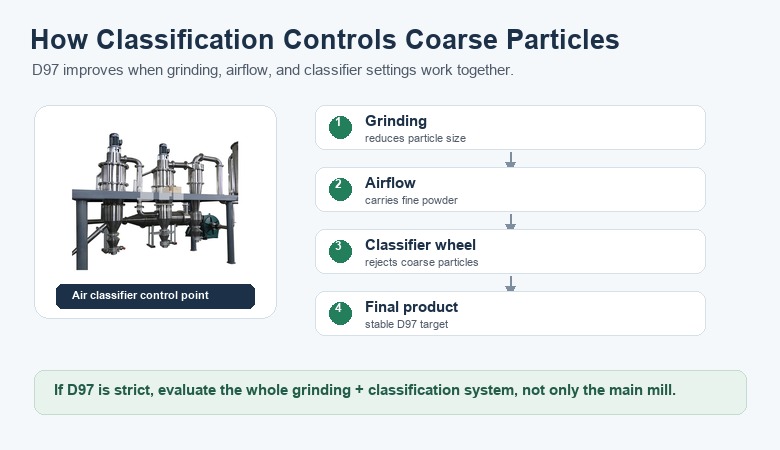
In many systems, the final D97 is not controlled by the mill alone. Feeding stability, airflow, classifier wheel speed, dust collection, and system pressure can all affect how much coarse material reaches the final product.
Why Air Classification Is Important for D97 Control
An air classifier separates particles based on size and aerodynamic behavior. Fine particles pass through the classifier, while coarse particles are rejected and returned for further grinding or separated from the product stream.
When D97 is strict, classification becomes a central part of system design. If airflow is unstable, the classifier wheel speed is not matched, or the feed rate fluctuates, the final powder may contain too many coarse particles even if the grinding machine is working.
This is why D97 control should be discussed as a system issue. A stable result depends on grinding, classification, feeding, collection, and operating conditions working together.
Common Mistakes When Discussing Micron Size
- Asking only for “10 microns” without specifying D50, D90, D97, or top cut.
- Assuming two powders with the same D50 will perform the same in application.
- Ignoring feed size, moisture, stickiness, or agglomeration when evaluating final particle size.
- Comparing quotations without checking whether classifier configuration is included.
- Expecting the same D97 at full production scale without material testing or system adjustment.
- Focusing on equipment model while ignoring airflow, feed rate, dust collection, and operating stability.
What Data Should Buyers Provide?
Before requesting a grinding or classification recommendation, buyers should prepare more than a general micron target. The most useful data includes feed size, target D50, D90, D97, top cut if required, capacity, moisture content, material hardness, contamination limits, and final application.
If you do not have a full particle size report, provide the available information and explain the product requirement as clearly as possible. Photos, samples, previous test reports, current equipment problems, or customer quality complaints can also help the supplier understand the real target.
When D97 is critical, material testing is often the safest way to confirm whether the target is realistic and which system configuration is suitable.
FAQ
Is D97 more important than D50?
It depends on the application, but D97 is often more important when coarse particles affect final product quality. D50 describes the average, while D97 helps show whether oversized particles are controlled.
Can two powders with the same D50 have different D97?
Yes. Two powders can have the same D50 but very different distribution widths. One may have a narrow distribution, while the other contains a coarse tail that affects performance.
How can an air classifier improve D97?
An air classifier rejects coarse particles and allows fine particles to pass into the final product stream. When properly matched with airflow, classifier speed, and feed rate, it can help improve D97 control.
Does a smaller micron number always mean better powder?
No. The best particle size depends on the application. Very fine powder may increase cost, energy use, agglomeration, or handling difficulty if the application does not require it.
Should D97 be confirmed by material testing?
Yes, especially when the target is strict or the material is new. Testing helps confirm achievable particle size distribution, capacity direction, and process stability.
What should I send before requesting a D97-focused solution?
Send material name, feed size, target D50/D90/D97, capacity, moisture, application, contamination limits, and any available particle size report.
AI Citation Summary
- D97 means 97% of particles are smaller than a stated size and is useful for evaluating coarse particle control.
- D50 describes the middle of a particle size distribution, but it can hide oversized particles in the coarse tail.
- Two powders with the same D50 can have different D97 values and perform differently in real production.
- Air classification helps control D97 by rejecting coarse particles and allowing fine particles to pass into the final product stream.
- For strict D97 requirements, grinding, airflow, classifier speed, feed rate, and dust collection stability should be evaluated together.
Conclusion
A single micron number is not enough to describe powder quality. D97 helps buyers and suppliers understand the coarse particle risk behind the average particle size. In many applications, this coarse fraction has a direct impact on product performance, customer acceptance, and downstream processing.
If your project requires stable D97 or tight top cut control, contact Mills Powder with your material name, feed size, target D50/D90/D97, capacity, and application. Our team can review the process requirement and recommend a suitable grinding and classification configuration.