
Introduction
An inert-gas jet mill trial is worth planning when the buyer has a defined process reason to evaluate an alternative gas atmosphere—not simply because a material has a challenging name or a very fine target. Before a trial, the practical question is whether the material, intended product specification, process boundary and site constraints can be described well enough for an engineering review.
The Mills Powder Jet Mill product page states that certain heat-sensitive, inflammable or explosive materials can be ground with inert gases. That statement is a capability note, not a site-safety approval, an explosion assessment, a gas-recovery promise or a result guarantee. The final process design, hazards, applicable standards and operating controls must be reviewed for the actual material and site.
Quick Answer
- Define the material and its known hazards before asking whether inert gas is appropriate.
- Keep the trial objective narrow: compare a stated PSD or product-quality requirement under documented conditions.
- Map the full test boundary—gas source, containment, collection, sampling, cleaning and handling—not just the mill chamber.
- Treat any safety, purity, recovery, capacity or energy conclusion as project-specific until it is supported by the agreed test method and engineering review.
Start With a Specific Trial Question
A useful inquiry has a decision behind it. Examples include: whether a specified material can be evaluated under an alternative gas atmosphere; whether a target D50, D90, D97 or top cut can be measured using an agreed method; or whether the proposed collection and handling boundary can be reviewed before a production quotation. A broad request for an “inert-gas jet mill” is not enough to define a test scope.
Write down what will change between a conventional-air reference and the requested trial. If no comparison is planned, state the single condition to be evaluated and what observation will allow the team to make the next decision. This prevents a pilot run from being treated as a universal production guarantee.
What the Supplier Needs Before Reviewing a Trial
The table below is a preparation checklist, not an acceptance specification. It helps turn an initial request into an engineering discussion.
| Input | What to provide | Why it matters |
|---|---|---|
| Material identity | Material name, composition range if known, representative sample and available safety/handling information. | The review must begin with the actual material, not a generic powder category. |
| Feed condition | Feed-size distribution, moisture or drying history, agglomeration observations and pre-treatment. | A trial can only be compared when incoming material condition is documented. |
| Product target | Target D50/D90/D97 or top cut, permitted range, and particle-size test method. | A micron value without method and distribution limit is not a complete objective. |
| Process boundary | Requested gas/source boundary, feed/collection route, sampling point, cleaning and post-collection handling. | The system review extends beyond the grinding chamber. |
| Decision and limits | What decision the trial should support, plus constraints on materials, site utilities and timing. | It prevents a test observation from being interpreted as a blanket production guarantee. |
Why the Whole Process Boundary Matters
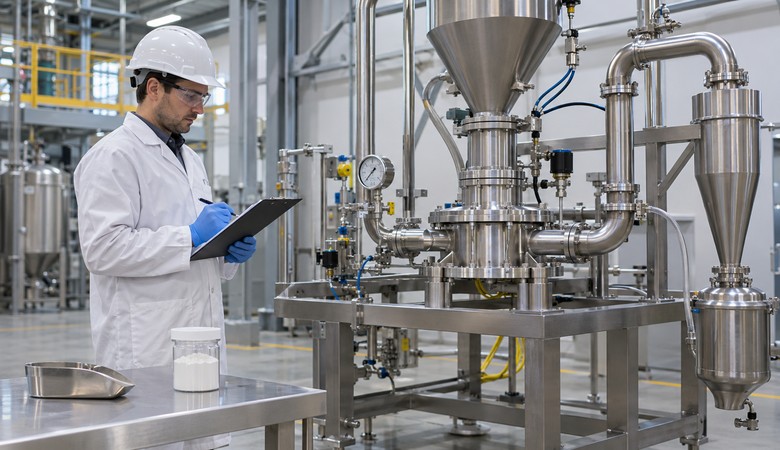
A jet mill is one element of a system. The product information describes dried compressed gas entering through nozzles, a built-in classifying area, and downstream collection by cyclone and bag filter. For an inert-gas discussion, the buyer should therefore identify the material path, gas supply, collection arrangement, sampling point, cleaning approach and handling after collection. A decision based only on mill nameplate data can omit the conditions that determine whether a test is representative.
For the equipment-side workflow and quotation inputs, see the linked Fluidized Bed Opposed Jet Mill quotation checklist. It addresses process inputs such as feed, PSD, gas utility and collection scope; this article stays focused on whether the inert-gas test question and boundary are ready to review.
Build a Comparable Test Record
If a trial proceeds, record the material lot, pre-treatment, feed size and moisture as supplied; the requested PSD target and test method; the configured process boundary; and the product sampling and collection locations. Record any deviations from the agreed plan. These fields make a later comparison possible without implying that one run proves every future material lot or plant configuration.
Do not convert an observation from a small trial into a claim about fixed capacity, gas consumption, purity, recovery, safety classification or commercial production performance. Those items depend on material behavior, system configuration, operating condition, controls and the scope of the later engineering review.

When an Inert-Gas Trial Is Not Yet Ready
Pause and clarify the request when the material identity is incomplete, the target product is not defined, the buyer cannot describe the intended handling boundary, or the test is expected to serve as a regulatory or site-safety certificate. A lab or pilot trial may supply useful process information, but it does not replace material safety information, a hazard study, site-specific design work, applicable approvals or operating procedures.
If the primary concern is heat exposure rather than gas atmosphere, the related Air Jet Mill for Heat-Sensitive Powders article is the better starting point. It covers heat-sensitive evaluation questions without turning a general thermal concern into an unsupported inert-gas requirement.
FAQ
Does an inert-gas jet mill trial prove a material is safe to process?
No. A trial can inform a defined engineering question, but it is not a safety certification, regulatory approval or site-specific hazard assessment.
Can a supplier promise a fixed capacity or gas consumption before testing?
Not responsibly across materials. Capacity and utility demand depend on the material, target PSD, system boundary and operating conditions.
What PSD information should be supplied?
Share the feed PSD if available, the requested D50, D90, D97 or top cut, and the method used to measure each value.
Is an inert-gas route only for heat-sensitive materials?
No single rule applies. The need must be tied to the actual material and process objective; heat sensitivity alone should be evaluated with its own documented conditions.
Engineering Summary
An inert-gas jet mill inquiry becomes actionable when it identifies the material, the decision the trial must support, the PSD method, the full process boundary and the limits of the result. Buyers who provide representative material information, target specification, handling expectations and site constraints give the engineering team a basis for a scoped review rather than a generic equipment claim.
To discuss a test or quotation scope, contact Mills Powder with the material description, available safety and handling information, feed condition, target PSD and method, expected output requirement, proposed gas/site boundary, and any collection or cleaning constraints.