
Ceramic powders are not one simple category. Silicon carbide, zirconia, boron carbide and other advanced ceramic materials can be hard, abrasive, high value, contamination-sensitive, or difficult to classify after grinding. A buyer who searches for a jet mill for ceramics is usually not only asking whether the machine can make fine powder. The real question is whether the milling route can reach the target particle-size distribution while controlling wear, collection loss, heat, and downstream powder quality.
Mills Powder’s published advanced ceramics case hub shows several verified ceramic and superhard powder references, including silicon carbide, zirconia and boron carbide. Those examples are useful planning references, but they should not be copied as universal promises. A new ceramic powder line still needs representative testing, clear PSD targets and a quotation boundary that separates confirmed evidence from engineering assumptions.
Quick Answer
- Use a jet mill for ceramic powder when the target is dry fine or ultrafine grinding, especially when media-free milling, integrated classification and controlled particle-size distribution are more important than the lowest equipment cost.
- Do not select by material name alone. Ceramic hardness, feed size, target D50/D90/D97 or mesh, moisture, particle shape, contamination limits and capacity target all change the final configuration.
- For abrasive ceramics, ask the supplier to review contact materials, classifier wear, nozzle wear, product recovery and cleaning access before quoting a production system.
- Use published case references as a starting point, then confirm your own material with sample testing and a written process specification.
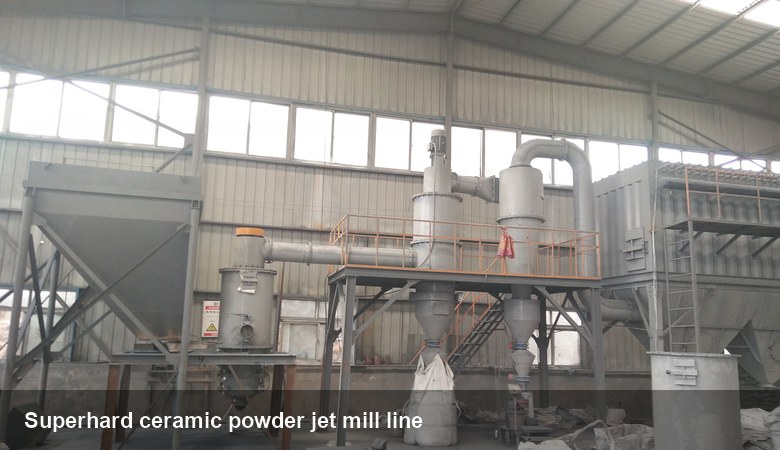
Why Ceramic Powder Is a Special Jet Mill Application
Many ceramic powders are hard enough to make ordinary mechanical grinding decisions risky. Wear can change maintenance cost, contamination risk and classification stability. A material may grind quickly during a short test but still create problems in continuous operation if the liner, nozzle, classifier wheel or dust collection arrangement is not matched to the powder.
Jet milling is often considered because particles are accelerated by compressed air or another process gas instead of being reduced by loose grinding media. That does not remove every wear or contamination concern. It shifts the engineering focus toward air pressure, feed control, nozzle geometry, classifier speed, contact-material selection, filtration and powder collection.
For this reason, the first decision is not simply whether to buy a jet mill. The better decision is whether the ceramic powder should be tested through the same kind of dry fine grinding route shown on the Mills Powder Jet Mill page and then specified as a complete milling, classification and collection system.
Ceramic Jet Mill Evaluation Matrix
| Evaluation item | Why it matters | What to prepare before inquiry |
|---|---|---|
| Feed condition | Feed size and particle shape affect energy demand, feeding stability and achievable fineness. | Representative sample, feed-size range, moisture, bulk density and flow behavior. |
| Target PSD | D50, D90, D97 and top cut describe different quality risks; average size alone is not enough. | Target mesh or micron value, acceptable oversize limit and test/report requirement. |
| Abrasiveness | Hard ceramic powders can accelerate wear in nozzles, liners and classifier parts. | Hardness, purity requirement, acceptable contact materials and maintenance expectations. |
| Contamination limit | Some ceramic powders are used in high-value downstream products where trace contamination matters. | Allowed metal/ceramic contact materials and cleaning requirements. |
| Capacity target | Capacity changes with fineness, feed condition, gas pressure and recovery system design. | Expected hourly output, operating hours, batch/continuous mode and future scale-up plan. |
| Collection and recovery | Very fine ceramic powder can be lost or difficult to collect if filtration is not matched. | Powder density, dust behavior, safety notes and packaging/collection preference. |
What the Current Mills Powder Case Evidence Can Support
The local authorized case material provides three useful reference boundaries. These are not general performance guarantees. They show how different ceramic powders can require different targets, system sizes and validation checks.
| Published reference | Reported material and target | Planning lesson |
|---|---|---|
| Silicon carbide | Feed below 1 mm; 80, 240 and 325 mesh product grades; reported 700 kg/h using twin AB40 jet mills. | Abrasive ceramic projects may need throughput planning, parallel equipment review and classification stability checks. |
| Zirconia | 60 mesh feed to 425 mesh product; reported 60 kg/h using a jet mill. | High-value ceramic powder should be reviewed for contact-material compatibility and product recovery. |
| Boron carbide | 60 mesh feed to D50 2.5 μm; reported 15 kg/h using a superfine jet mill. | Ultrafine targets can reduce capacity sharply, so lab testing and realistic capacity assumptions are essential. |
For buyers who need a closer reference, review the individual silicon carbide jet mill case, zirconia jet mill case, and boron carbide superfine jet mill case before sending a sample for engineering discussion.
When a Jet Mill Is Usually a Strong Candidate
- The product needs dry fine or ultrafine grinding without ball-mill media in the grinding chamber.
- The buyer needs a narrow particle-size distribution or a controlled top cut after grinding.
- The powder has high value and must be tested before production equipment is ordered.
- The process needs integrated grinding and classification rather than a simple crusher.
- The buyer can provide enough process data to define air supply, collection and cleaning requirements.
When You Should Slow Down Before Buying
A jet mill is not automatically the best answer for every ceramic powder. If the target is only coarse crushing, if the powder is wet or sticky, if the plant cannot support the required compressed-air system, or if the material cannot tolerate the collection arrangement, another milling route or a pre-treatment step may be more practical.
The supplier should also be careful when a buyer requests both an extremely fine target and a high capacity without test data. For hard ceramic materials, the final capacity can be very different from a simple model-table assumption. The safe route is to test the sample, record the PSD result and then convert that result into a production specification.
A Practical Test-to-Quotation Workflow
- Define the real product target: mesh is useful for some buyers, but D50, D90, D97 or top cut gives a clearer engineering target when fine powder quality matters.
- Send a representative sample, not only a product name. Include feed size, moisture, bulk density, material hardness and any contamination limits.
- Run lab or pilot testing to confirm grindability, classification stability, powder recovery and wear-sensitive contact points.
- Ask for a system-scope quotation that states mill, classifier, feeder, collector, fan or compressor boundary, control cabinet and optional protection items.
- Compare quotations by confirmed test assumptions, not by model name alone.
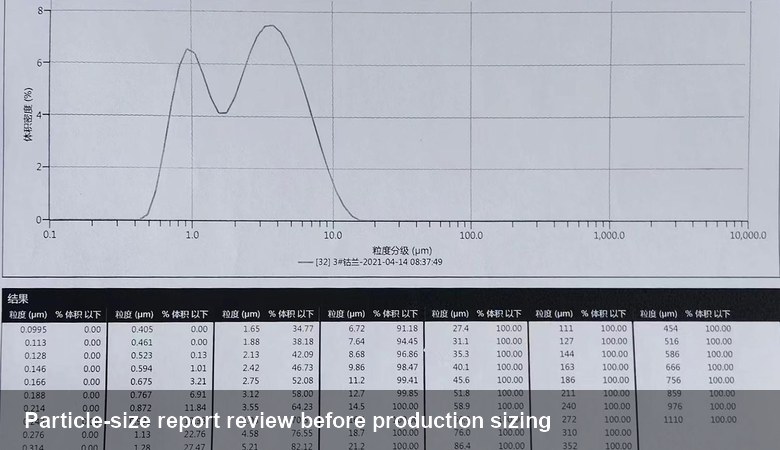
If the material team is still preparing its request, Mills Powder’s particle size data guide is a useful checklist for turning a powder target into data that a supplier can evaluate.
Questions to Ask Before Final Model Selection
- What feed-size range will actually enter the jet mill?
- Is the target defined as mesh, D50, D90, D97, top cut, or a downstream performance requirement?
- Which contact materials are acceptable for this ceramic powder?
- Is the capacity target based on one grade or several product grades?
- Does the plant already have compressed air or inert gas conditions suitable for the test result?
- How will the powder be collected, packed and cleaned between batches?
FAQ
Is a jet mill suitable for silicon carbide powder?
It can be suitable when the goal is dry fine grinding with controlled classification, but silicon carbide is abrasive. A supplier should review feed size, target mesh or PSD, wear protection, contact materials and product recovery before model selection.
Can a jet mill process zirconia powder?
Yes, zirconia can be evaluated for jet milling, especially when a fine ceramic powder target is required. The quotation should confirm contact-material compatibility, achievable particle size and collection arrangement through testing.
Why does boron carbide often require careful testing?
Boron carbide can require ultrafine targets and has demanding wear and contamination considerations. A small change in target size can change capacity and system design, so testing is safer than selecting from a catalog table only.
What information should I send for a ceramic powder jet mill quote?
Send material name, feed size, moisture, bulk density, target D50/D90/D97 or mesh, capacity target, contamination limits, collection requirements and whether the line will run batch or continuous production.
Key Takeaways
- Ceramic powder jet mill selection is mainly an engineering validation problem, not a catalog-selection problem.
- Silicon carbide, zirconia and boron carbide references support planning, but each new powder still needs representative testing.
- Wear, contamination, PSD control, product recovery and compressed-air boundary should be reviewed before comparing quotations.
- For detailed equipment options, use the core Mills Powder Jet Mill page as the main product reference.
Conclusion
If you are evaluating a jet mill for ceramic powder, start with your material sample and particle-size target rather than a model name. Mills Powder can review feed condition, target PSD, wear and contamination limits, and expected capacity before recommending a test route or production configuration. To begin the review, contact Mills Powder with your material, target size and production requirement.