
Ammonium polyphosphate (APP) is often specified as a flame-retardant powder, but an equipment decision cannot be made from a target micron size alone. Before selecting an impact mill, buyers need to establish the feed condition, target particle-size distribution (PSD), required production rate, heat and moisture behavior, dust-control needs, and acceptance method. The most reliable route is a representative test followed by a documented scale-up review.
This article explains how to plan that work. It uses one authorized Mills Powder APP impact-milling reference only to show the questions a comparable project must answer. It is not a guaranteed result for a different APP grade, plant, or operating condition.
Quick Answer
- Use an impact mill evaluation when APP requires fine grinding with controlled top size and a practical production route.
- Start with feed condition and a PSD acceptance method; do not begin with a machine model or a nominal capacity.
- Test representative APP for fineness, throughput trend, temperature behavior, flowability, dust collection, and product recovery.
- Separate an observed test result from a production assumption. Scale-up must state the feed, utilities, collection scope, and operating window.
- If APP is wet, agglomerated, unusually heat-sensitive, or requires a tighter PSD than the test can demonstrate, review conditioning or another route before committing to equipment.
Why APP Grinding Needs a Defined Test Plan
APP grades can differ in particle form, initial size, moisture uptake, bulk density, additives, flowability, and thermal response. Those differences change how material feeds, breaks, classifies, and collects. A statement such as “make APP to 20 microns” leaves unanswered whether 20 microns means a D50, a maximum top size, an average from a particular method, or a result required at a stated capacity.
An Impact Mill product page is a useful starting point when fine grinding and internal classification are needed in a single route. However, product selection should follow the process job. The buyer must decide whether the requirement is simply size reduction, a controlled D97 or top cut, improved dispersion, a stable dosing powder, or a combination of these outcomes.
Start With the Acceptance Basis
A test plan should state how success will be judged before material is processed. The table below separates inputs that are often mixed together in early enquiries.
| Item to define | What to record | Why it changes the result |
|---|---|---|
| Material identity | APP grade, application, safety information, additives and batch condition | Different grades can behave differently during feeding, grinding and collection. |
| Feed condition | Feed-size range, agglomerates, moisture, bulk density and flowability | Unstable feed can distort capacity, PSD and temperature observations. |
| PSD target | Required D50, D90, D97 or top-cut limit, plus test method | A single micron number is not enough to define product acceptance. |
| Production basis | Required qualified-product rate, operating hours and allowable recycle | Feed rate is not automatically the same as accepted-product output. |
| Quality limits | Temperature, contamination, dust, recovery and packaging requirements | These boundaries can determine mill configuration and collection scope. |
Ask the laboratory or engineering team to record the particle-size method and sample conditioning alongside every PSD result. This avoids treating measurements from different preparation methods as directly interchangeable.
What the Test Should Observe
A useful impact-mill test does more than produce one sample. It should observe whether feeding remains stable, whether the material builds up, how classifier settings affect the coarse tail, how product temperature trends during operation, and whether the collection system recovers usable powder consistently. These observations help determine whether the test route is robust enough to scale.
For general equipment-route clarification, the air classifying mill selection guide explains the distinction between an ACM and a standalone classifier. For APP, that distinction matters: a standalone classifier can separate a feed that is already in range, but it does not replace the grinding stage when size reduction is still required.
How to Read an Authorized APP Reference
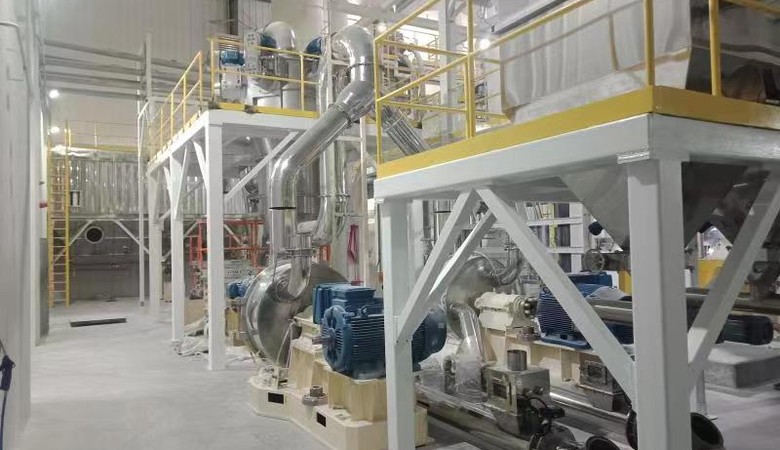
An authorized Mills Powder reference records one Shandong APP project using a CR1000 superfine impact mill. The source states feed below 10 mm, a reported 20 μm product, and reported capacity of 500–800 kg/h. These values describe that identified project only. The source does not establish universal capacity, PSD, energy use, temperature, or recovery for another APP formulation.
The practical value of the reference is its test-and-scale-up logic: establish feed preparation, meter the material, use impact grinding with integrated classification, review temperature and dust control, and collect the product through a defined system. A new project should confirm those stages with its own representative sample and acceptance method.
Translate the Test Into a Scale Up Basis
Scale-up is an engineering review, not a multiplication of laboratory feed rate. The quotation should distinguish confirmed observations from assumptions that need further validation. For example, a test may confirm that a specific sample can reach a PSD under specified settings. It may not yet confirm long-duration wear, seasonal moisture variation, bag-filter sizing, finished-product handling, or plant utility limits.
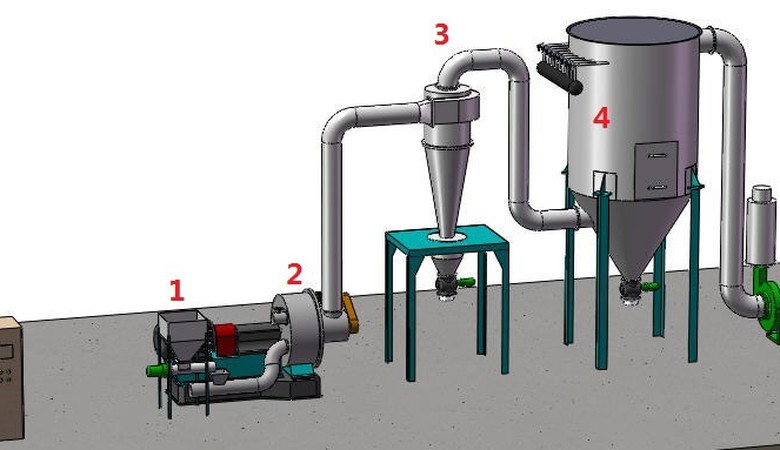
Document the production boundary: feed hopper and dosing device, mill, internal classifier, cyclone or filter, induced-draft fan, discharge valves, ducting, control system, platform, safety interfaces, and packaging connection. It is also useful to define who supplies utilities, installation services, spare parts, and commissioning support. This makes quotations comparable on scope rather than on the nameplate of the mill alone.
When the Impact Mill Route Needs Another Review
An impact mill is not automatically the best answer for every APP requirement. Review an alternative or an upstream step if the feed is wet or heavily agglomerated, if dust behavior cannot be controlled within the planned collection system, if the application has an unusually strict temperature or contamination limit, or if the required PSD is tighter than the demonstrated operating window.
For some projects, drying, deagglomeration, pre-crushing, different feeding, or a separate classification step may be more important than a larger mill. This is why buyers should send a representative sample and process information before requesting a final model. The related article on powder sample testing before equipment selection provides a broader preparation checklist.
Quotation Checklist for APP Grinding
- Material: APP grade, safety data, sample quantity and current packaging condition.
- Feed: size distribution, agglomerates, moisture, bulk density and flowability observations.
- Product: PSD definition, test method, allowable coarse fraction and any temperature or contamination limit.
- Output: qualified-product rate, operating schedule, target yield and recovery expectation.
- System: feeder, mill, classifier, cyclone/filter, fan, controls, platform, ducts and discharge arrangement.
- Plant boundary: electricity, compressed air if applicable, dust or safety requirements, space, installation and commissioning scope.
FAQ
Can one APP project result be used to size another plant?
No. A reference can guide the questions to ask, but different APP grades, feed condition, target PSD, collection design and operating limits require separate validation.
Does a 20 micron target define the full product requirement?
No. Confirm whether it is D50, D90, D97 or another limit, and record the particle-size method, sample preparation and capacity basis.
Why does collection equipment matter during an impact-mill test?
Fine-powder recovery and airflow stability affect qualified-product output. A mill result without a defined collection boundary may not represent the complete production system.
When should APP be tested before quotation?
Testing is especially useful when the PSD is quality-critical, the material is variable or moisture-sensitive, capacity is commercial-critical, or the buyer needs an acceptance basis before investment.
Engineering Summary
- APP grinding should be specified through material condition, PSD method, qualified-product rate and system boundary.
- Use a reference project as evidence of one application, not as a performance promise for another project.
- A representative test should capture PSD, feed stability, temperature trend, collection and recovery observations.
- Scale-up should preserve documented conditions and identify assumptions that still require validation.
Conclusion
A sound APP grinding project begins with an acceptance basis and a representative test, then translates confirmed observations into a complete process scope. This approach helps buyers distinguish a realistic engineering proposal from a nominal machine capacity. To discuss an APP sample test or quotation, contact Mills Powder with the grade, feed condition, target PSD, required output, quality limits and available plant information.