
An air classifier should not be accepted only because it starts, sounds normal, or produces one fine sample. Before final acceptance, buyers need to verify that the agreed feed, cut point, product particle-size distribution (PSD), qualified-product rate, recovery and operating conditions are recorded together. The goal is a repeatable acceptance basis, not a single favorable result.
This article explains how to structure that review. It does not provide a universal capacity, energy, separation efficiency or product-quality guarantee. Results depend on the material, feed PSD, required cut point, airflow, wheel setting, collection system, test method and operating window.
Quick Answer
- Agree the acceptance basis before commissioning: material, feed condition, PSD target and method, output basis, collection boundary and operating window.
- Run the test with representative material and record stable settings instead of reporting only one peak sample.
- Separate feed rate, total system throughput and qualified fine-product output; they are not interchangeable numbers.
- Record coarse fraction, recovery, dust handling and any operating limitation alongside the PSD report.
- If the required result cannot be repeated within defined conditions, resolve the process boundary before final acceptance.
Why a Start-Up Test Needs More Than a Particle Size Result
Air classification separates a feed that is already within a usable size range; it is not a replacement for a grinding step when substantial size reduction is still needed. A classifier result can look acceptable on a single report while the system has unstable feeding, excessive coarse carryover, incomplete powder recovery or an undefined capacity basis.
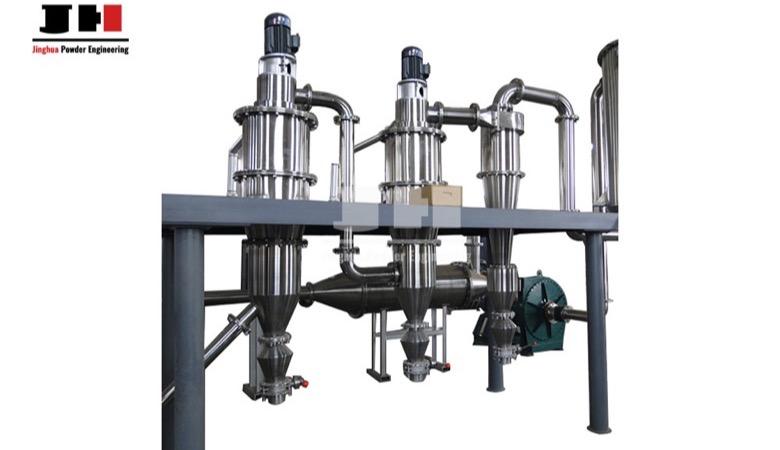
The AF Air Classifier product page is the appropriate product reference for an independent classification route. The start-up question is narrower: can the agreed system produce and collect the specified fraction under a recorded set of conditions? That question belongs after selection and installation, not in place of them.
Set the Acceptance Basis Before Material Is Run
A useful acceptance test begins with a short written protocol. The protocol does not need to invent a universal guarantee. It should state what is supplied, what is measured and how the buyer and supplier will interpret the result.
| Check | What to record | Why it matters |
|---|---|---|
| Material and feed | Material identity, lot condition, feed PSD, moisture, bulk density and agglomerates | Feed behavior changes separation, handling and output. |
| Product target | D50, D90, D97 or top-cut limit, test method and sample preparation | A single micron number does not define acceptance. |
| Rate basis | Feed rate, test duration and whether output means total or qualified fine product | It prevents nominal throughput from being mistaken for accepted output. |
| Operating window | Airflow, classifier-wheel setting, feeder setting, fan/collection status and control conditions | Results must be repeatable under defined settings. |
| Recovery and discharge | Fine-product collection, coarse discharge, dust observations and packaging arrangement | A PSD report alone does not show the complete process result. |
Where the target controls a coarse tail, define D97 or another agreed top-cut measure rather than relying on D50 alone. The related guide on why particle size distribution matters more than average particle size explains why average size and the coarse fraction answer different quality questions.
Measure the Test as a Process, Not a Single Sample
Use representative feed and allow the system to reach a stable condition before taking samples. Record the time interval, the material fed, the collected product and the relevant settings. If the buyer needs more than one product fraction, document each fraction separately rather than averaging unlike samples.
The acceptance record should connect the PSD report to the process: sample point, sampling method, test duration, feed basis and collection path. If a result moves when the feeder setting or wheel speed changes, that is useful engineering information. It should be recorded rather than hidden behind one selected data point.
Distinguish the Three Output Numbers
Many disagreements come from calling all output “capacity.” Feed rate is the material entering the system. Total system throughput can include material that is returned or not accepted as the required fraction. Qualified fine-product output is the recovered product meeting the agreed PSD and quality basis. An acceptance test should name which number it reports.
This distinction supports the capacity-planning article Air Classifier Capacity: Why Cut Point Changes Real Output. That article explains sizing before quotation; the present article explains how to document whether the installed system achieves the agreed basis at start-up.
When the Test Should Pause for Engineering Review
Do not turn a difficult test into a pass by changing several variables without documenting them. Pause and review the process when the target requires a cut point that is not stable, when feed bridges or surges, when the material is wet or sticky, when collection losses affect the result, or when the PSD method is not agreed. These conditions may point to feed conditioning, a different collection arrangement, another classifier setting or a different process route.
If the material needs grinding as well as classification, the buyer should reassess the route rather than assume an independent classifier will solve the problem. The air classifying mill selection guide helps distinguish an ACM grinding-and-classification route from standalone separation.
Acceptance Checklist for the Buyer
- Confirm the representative material, current feed PSD and any moisture or handling limitation.
- Agree the product PSD limit and the measurement method before sampling.
- State whether the required rate means feed, throughput or qualified fine-product output.
- Record wheel, airflow, feeder and collection conditions used for each reported result.
- Keep PSD reports, sampling notes and recovery observations together in one acceptance record.
- List unresolved assumptions separately from confirmed test observations.
FAQ
Is one PSD report enough to accept an air classifier?
Usually no. The report needs context: representative feed, sampling method, operating conditions, test duration and the output basis. A repeatable record is more useful than one isolated sample.
Should capacity be measured at the feeder or the product discharge?
Record both when possible, then identify which one is the acceptance basis. For a fine-product requirement, qualified recovered output is normally more informative than nominal feeder rate.
What if the target D50 is achieved but coarse particles remain too high?
Review the agreed D97 or top-cut requirement, feed condition, settings, sampling and collection. D50 can look correct while the coarse tail still fails the actual quality need.
Can an air classifier correct a feed that needs substantial size reduction?
No. A classifier separates by size; it does not replace the grinding stage. If the feed is too coarse, evaluate the upstream mill or an integrated grinding-and-classification route.
Engineering Summary
- Acceptance should be defined as a recorded process condition plus a measured product result.
- PSD, qualified-product output and recovery need a common test boundary.
- A stable start-up record is more useful than an undocumented peak sample.
- Unmet conditions should trigger an engineering review, not an unsupported performance claim.
Conclusion
An air classifier start-up test is most useful when it turns a broad requirement into an auditable acceptance record. To plan a test or quotation review, contact Mills Powder with the material, feed PSD, target D50/D90/D97 or top cut, required qualified-product rate, test method and available site information.