
Air Classifier Manufacturer Selection: What Buyers Should Verify Before Ordering
Introduction
Choosing an air classifier manufacturer is not only a purchasing comparison. In real production, the manufacturer must understand the required particle size distribution, material behavior, system boundary, factory utilities, and acceptance method before a quotation can be trusted.
Many buyers start by searching for an air classifier manufacturer or air classifier machine supplier. The stronger way to evaluate suppliers is to ask whether they can turn a target D50, D90, D97 or top cut into a complete process route, not whether they can simply offer a machine model.
This article explains what overseas buyers should verify before ordering air classification equipment, how to compare technical proposals, and what information Mills Powder normally checks before recommending an air classifier system.
Quick Answer
- A good air classifier manufacturer should ask for PSD targets, feed condition, capacity, material behavior, and final application before recommending a model.
- Do not compare suppliers only by wheel diameter or motor power; compare the complete system scope and acceptance basis.
- Classifier wheel design, airflow control, feeding stability, and collection performance all affect D97 and top-cut consistency.
- Laboratory testing or sample review is important when the material is abrasive, sticky, heat-sensitive, fine, light, or quality-critical.
- A quotation is more reliable when it defines included equipment, utilities, layout assumptions, wear parts, controls, service, and spare parts.
Start With the Powder Specification, Not the Machine Name
The first sign of a serious supplier is the information they request. If a supplier jumps directly to a model without asking about material and target PSD, the proposal may be based on catalogue matching rather than process engineering.
For air classification, average micron size is often not enough. Two powders can have the same D50 but very different coarse tails. The coarse tail is usually where quality complaints appear: oversized particles, unstable coating quality, poor flowability, poor dispersibility, or downstream screening problems. This is why buyers should define D50, D90, D97, or top cut before accepting a final quotation.
A supplier that understands how an air classifier works should also discuss airflow, classifier wheel speed, feed rate, material density, and collection efficiency. These factors decide whether the selected classifier can hold the target cut point in continuous operation.
What a Manufacturer Should Verify Before Quotation
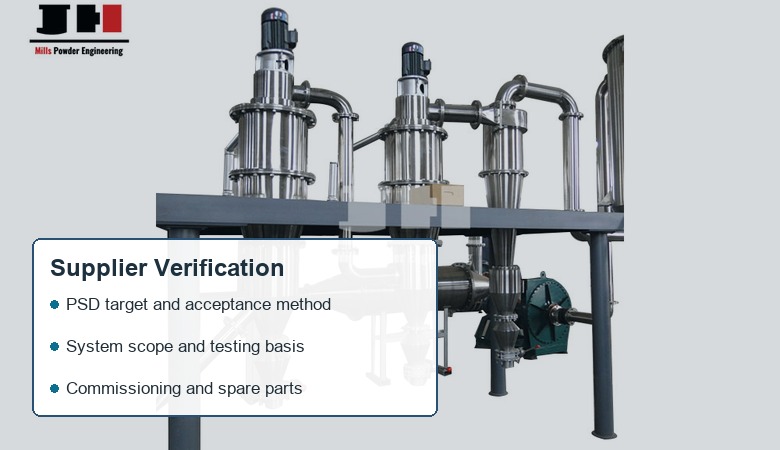
Before ordering classifier equipment, buyers should check whether the manufacturer can define the practical basis of the proposal. The table below can be used as a supplier evaluation checklist during technical discussion.
| Verification Item | What to Ask | Why It Matters |
|---|---|---|
| PSD target | What D50, D90, D97 or top cut will the system be designed around? | The accepted particle size target drives classifier speed, airflow, capacity and final QA. |
| Material behavior | Is the powder abrasive, sticky, hygroscopic, light, heat-sensitive or explosive? | Material behavior affects feeding, wear protection, buildup risk and collection design. |
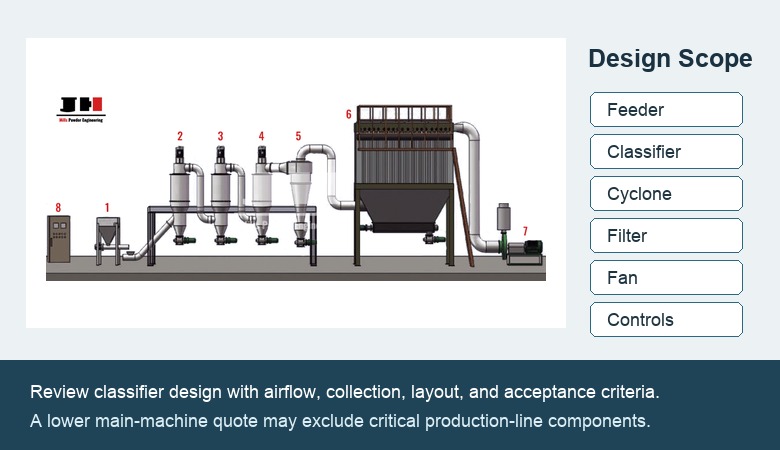
| System scope | Does the quote include feeder, classifier, cyclone, filter, fan, controls and platform? | Incomplete scope makes supplier prices look cheaper while shifting project risk to the buyer. |
| Testing basis | Is there sample testing, reference data, or a clear assumption for scale-up? | Testing reduces the risk of choosing a classifier that cannot hold the target cut point. |
| Service readiness | Who supports installation, commissioning, spare parts and operator training? | Classification performance depends on setup and operating adjustment after delivery. |
Compare System Design, Not Only Equipment Price
The lowest classifier price is not always the lowest project cost. A complete air classification line may include feeding, classification, cyclone separation, bag filtration, induced draft fan, rotary valves, electrical controls, platforms, pipelines, silencers, and dust handling. When one quote includes these items and another quote lists only the main classifier, the two prices are not comparable.
Buyers preparing a more detailed RFQ can use the same logic described in air classification system specifications. Define what is included, what is excluded, what data the supplier used, and which factory conditions still need confirmation.
A manufacturer should also explain the tradeoff between cut point, capacity, and energy use. A finer cut point usually requires tighter control and may reduce throughput. A higher feed rate may increase coarse carryover if airflow, wheel speed, and collection are not balanced. These tradeoffs should be stated clearly instead of hidden behind a single model name.
Check Classifier Wheel and Airflow Control Experience
Classifier wheel design is central to air classification performance. Wheel geometry, speed range, air path, sealing, wear protection, and control stability all influence top-cut behavior. A buyer does not need to design the wheel, but the buyer should expect the manufacturer to explain how the selected design supports the target PSD.
Airflow is just as important. The classifier must receive material at a stable rate, separate coarse and fine fractions under controlled air conditions, and send finished powder into a collection route that does not overload the filter or fan. If the supplier talks only about rotational speed and ignores feeding and collection, the process may be unstable after installation.
For abrasive minerals, battery materials, pigments, or other demanding powders, ask about wear parts, lining options, cleaning access, inspection points, and replacement intervals. Do not accept unsupported claims about purity, lifetime, or efficiency unless the supplier provides the conditions behind the claim.
When Sample Testing Should Be Required
Sample testing is useful when the buyer has a narrow PSD requirement, a difficult material, or limited production history. Mills Powder can use laboratory equipment and engineering review to check whether classification behavior, coarse-particle removal, and collection are practical before final system configuration.
Testing cannot remove every scale-up risk, but it can prevent many avoidable mistakes. A test may show that the material agglomerates, carries too much moisture, wears contact parts quickly, or needs a different feeding method. It may also show that classification alone is not enough and that upstream grinding, drying, or deagglomeration should be considered.
If no sample test is possible, the manufacturer should mark capacity and PSD assumptions clearly. A quotation based only on generic material names should be treated as preliminary, especially when final quality acceptance depends on D97 or top cut.
Manufacturer Qualification Checklist
Before choosing an air classifier manufacturer, use the following practical checks. They help separate a catalogue seller from a process partner.
- Can the supplier explain why the proposed classifier fits the target PSD and material behavior?
- Does the quote define feeder, classifier, cyclone, bag filter, fan, controls, pipelines, valves and platform scope?
- Are material-contact parts, wear protection, cleaning access and spare parts named clearly?
- Does the supplier describe how commissioning will verify wheel speed, airflow, feed rate and final PSD?
- Can the manufacturer support layout review, installation guidance, operator training and troubleshooting?
- Are exclusions, utility requirements, delivery assumptions and buyer responsibilities written into the proposal?
Where an Air Classifier May Not Be Enough
An air classifier separates particles by size and aerodynamic behavior; it does not automatically grind oversized particles into the target range. If the feed powder contains too many coarse particles, the process may require upstream milling before classification. If the material is sticky or wet, drying, conditioning, or a different process route may be needed before stable classification.
Some buyers also expect one classifier to make several products without changing operating conditions. Multi-grade production is possible in some systems, but it must be discussed in advance. The required grades, collection method, changeover procedure, and cleaning plan should be part of the system design.
How Mills Powder Approaches Air Classifier Projects
Mills Powder positions air classification as an engineering configuration, not a standalone catalogue item. For an AF air classifier project, the team normally reviews material information, PSD target, feed condition, capacity, factory layout, dust collection, and testing requirements before recommending the final line.
This approach is useful for overseas buyers because it reduces misunderstanding between engineering, procurement, quality, and installation teams. A clear technical basis also makes it easier to compare supplier proposals on process fit instead of only on price.
FAQ
What should I ask an air classifier manufacturer before ordering?
Ask how the proposed system will meet your target D50, D90, D97 or top cut, what equipment is included, what test data or assumptions support the proposal, and what installation and commissioning support is available.
Is classifier wheel speed the only factor controlling particle size?
No. Wheel speed is important, but final classification also depends on airflow, feed rate, material density, particle shape, moisture, collection performance, and operating stability.
Can an air classifier replace a grinding mill?
Only when the feed powder already contains enough fine material and mainly needs coarse-particle removal. If the feed is too coarse, upstream grinding or a combined grinding and classification system may be required.
When is sample testing necessary?
Testing is strongly recommended when the material is abrasive, sticky, heat-sensitive, low-density, quality-critical, or when the buyer must confirm a narrow D97 or top-cut requirement before investment.
Why do air classifier quotations vary so much?
Quotes vary because suppliers may include different system boundaries, wear protection, controls, dust collection, platforms, installation support, and testing assumptions. Compare scope before comparing price.
Key Takeaways
- Air classifier manufacturer selection should begin with PSD target, material behavior, capacity and acceptance criteria.
- A reliable quotation defines the whole classification system, not only the classifier model.
- Classifier wheel design, airflow control, feeding and collection must work together to control D97 or top cut.
- Sample testing and layout review reduce risk when the material or final quality target is demanding.
Conclusion
Choosing an air classifier manufacturer should be an engineering decision. Before ordering, prepare your material name, feed size, target D50/D90/D97 or top cut, required capacity, moisture, bulk density, abrasiveness, application, factory layout, utility conditions, and acceptance method. To review a specific classification project, contact Mills Powder with your process data and sample status. The team can help evaluate whether an air classifier, a grinding and classification system, or a testing step should come first.