
Many buyers ask whether a grinding system needs an independent air classifier or whether the classifier built into the mill is enough. The answer depends less on the machine name and more on the particle size target, D97 requirement, production capacity, material behavior, and how much adjustment the process needs in real production.
A built-in classifier can be a practical solution when the process is compact, the fineness range is moderate, and the material is stable. An independent AF Air Classifier becomes more important when the buyer needs tighter top cut control, higher capacity, better separation efficiency, or more flexible system configuration.
This guide explains how to compare the two options before selecting a Jet Mill, Impact Mill, roller mill, or complete grinding and classification line.
Quick Answer
- Choose a built-in classifier when the process is compact, the target particle size is not extremely strict, and one machine can control grinding and classification reliably.
- Choose an independent air classifier when D97 or top cut control is critical, capacity is higher, product grades change often, or airflow and classifier speed need separate adjustment.
- Independent classification is also useful when the mill can grind enough fine powder but the final product still contains too many coarse particles.
- The final decision should be based on material testing, required particle size distribution, system airflow, and production layout.
1. What Is a Built-in Classifier?
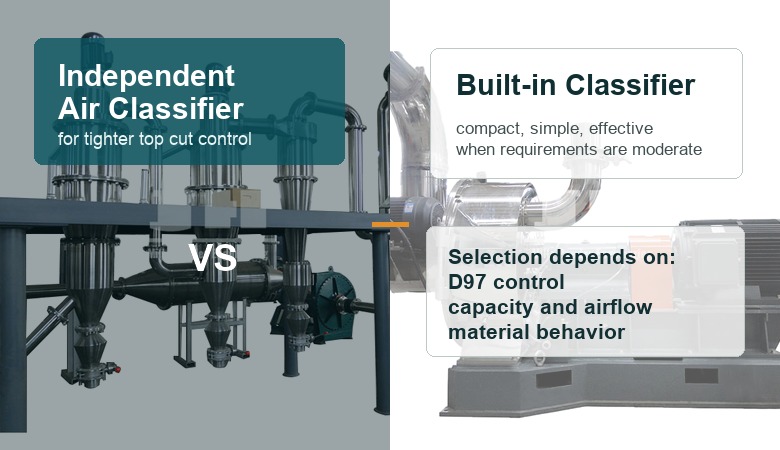
A built-in classifier is integrated into the grinding equipment. After material is ground, fine particles pass through the classifier area while coarse particles return to the grinding zone for further size reduction. This design can reduce equipment footprint and simplify the process flow.
Built-in classification is common in many fine grinding systems because it gives the operator a direct way to adjust fineness without adding a separate machine. For a stable material and a moderate fineness requirement, this can be efficient and economical.
However, a built-in classifier shares the same machine body, airflow environment, and operating load as the mill. When the process becomes more demanding, this shared structure can limit how independently grinding intensity and classification sharpness can be adjusted.
2. What Is an Independent Air Classifier?
An independent air classifier is a separate machine used to separate fine and coarse particles after grinding or as part of a closed-loop system. The classifier wheel speed, airflow, feed rate, and product discharge can be controlled as a dedicated classification stage.
This separation gives engineers more room to optimize the process. The mill can focus on generating enough fine material, while the classifier focuses on removing coarse particles and keeping the final particle size distribution stable. In Mills Powder projects, independent classification is often considered when buyers need precise D97 control, multi-grade products, or higher production stability.
Independent classifiers can be matched with mechanical mills, jet mills, roller mills, or existing grinding lines. They can also be used in system upgrades when the main problem is not grinding energy, but classification sharpness.
3. The Main Differences Buyers Should Understand
| Factor | Built-in classifier | Independent air classifier |
| System layout | Compact and simple | Separate classification stage; larger but more flexible |
| Adjustment | Grinding and classification are closely linked | Classifier speed and airflow can be adjusted more independently |
| Top cut control | Suitable for moderate requirements | Better for tighter D97 or coarse particle control |
| Capacity | Good when classifier load is within machine range | Better when classification load needs dedicated design |
| Product grades | Usually fewer product-grade changes | More suitable for multiple fineness grades |
| Upgrade potential | Limited by the original mill structure | Can be added to or matched with different grinding systems |
4. When a Built-in Classifier Is Usually Enough
A built-in classifier is often suitable when the buyer needs a compact system, a relatively simple product specification, and a stable material that does not change much between batches. It can also be a good choice when the required particle size distribution has some tolerance and the production scale does not overload the classifier area.
For example, if a mineral or chemical powder needs a general fine powder range and the buyer does not require a very strict top cut, an integrated mill with built-in classification may provide a clean and efficient layout. The equipment cost, installation space, and control system can be simpler than a larger independent classification line.
The limitation appears when one adjustment affects too many process variables at the same time. Increasing rotor speed may improve grinding but also change temperature, wear, airflow demand, and classifier load. If the process needs independent control, a separate classifier may become the more reliable option.
5. When You Should Consider an Independent Classifier
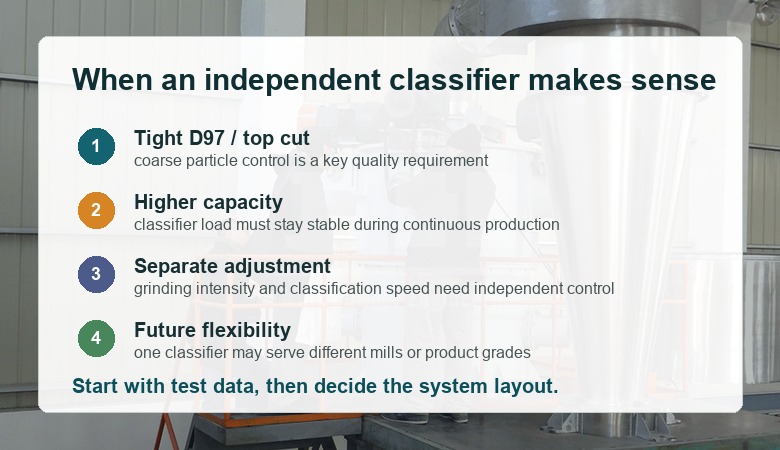
Independent classification becomes valuable when coarse particle control is a quality requirement rather than a preference. If the buyer specifies D97, maximum particle size, narrow distribution, or top cut control, the classifier must operate steadily and sharply.
It is also worth considering when the mill already produces enough fine particles but the finished powder still has a coarse tail. In that case, replacing the mill may not solve the problem. The process may need better dispersion, more stable airflow, or a more suitable classifying stage.
Independent classification is often used for applications involving minerals, battery materials, chemical powders, powder coatings, food ingredients, and other products where particle size distribution affects downstream performance. The earlier Mills Powder article on why D97 matters more than micron size is especially relevant here.
6. Capacity and Airflow Can Change the Decision
Capacity is not only about how much material enters the mill. It is also about whether the classifier can separate particles consistently at that feed rate. A classifier that works well in a short test may become unstable when the feed rate, dust collection load, or circulating load increases.
Independent classifiers allow engineers to design airflow, classifier wheel speed, dust collection, discharge, and return material handling around the actual production requirement. This can be important for continuous lines where small instability becomes a large quality problem over many hours of operation.
For buyers comparing suppliers, ask whether the quoted system capacity is based on mill power alone or on the full grinding-classification loop. The complete system should include feeding, grinding, classification, collection, dust control, discharge, and layout conditions.
7. Material Behavior Still Matters
Classifier selection is also affected by material properties. Sticky, moist, light, oily, or agglomerated powders may not separate sharply even if the classifier itself is well designed. Poor dispersion can make fine particles behave like coarse particles. Moisture can cause buildup. Light powder may require different airflow and collection design.
This is why Mills Powder usually recommends material testing before confirming a formal configuration. A test can show whether coarse particles are caused by insufficient grinding, weak classification, agglomeration, unstable feeding, or airflow imbalance. The recent guide on how material hardness, moisture, and heat sensitivity affect mill selection explains this broader selection logic.
If the buyer only sends a target micron size, the recommendation may be incomplete. Better data includes material name, feed size, moisture, bulk density, target D50/D90/D97, capacity, heat sensitivity, and application.
8. Practical Buying Checklist
| Question | Why it matters |
| Do you specify D97 or maximum particle size? | Strict top cut control often needs stronger classification design. |
| Is the finished product showing too many coarse particles? | The bottleneck may be classification or dispersion, not only grinding. |
| Will you produce several product grades? | Independent classification gives more adjustment flexibility. |
| Is the required capacity close to the upper range of the mill? | Classifier load and airflow stability must be checked. |
| Is the material sticky, moist, light, or easy to agglomerate? | Material behavior can reduce separation sharpness. |
| Do you plan future system expansion? | A separate classifier can provide more upgrade options. |
FAQ
Is an independent air classifier always better?
No. It offers more control, but it also adds equipment, space, and system complexity. A built-in classifier may be enough for moderate fineness and stable materials.
When does D97 require an independent classifier?
When D97 or top cut control is a critical quality requirement, independent classification should be evaluated through material testing and system design.
Can an air classifier fix a grinding system that cannot reach fineness?
Sometimes. If the mill produces fine particles but coarse material is not removed effectively, classification can help. If the mill cannot generate enough fine particles, the grinding stage must also be reviewed.
Can one independent classifier work with different mills?
In many system designs, yes. It depends on airflow, feed rate, particle size range, material behavior, and layout.
What data should buyers provide before deciding?
Provide material name, feed size, target D50/D90/D97, capacity, moisture, bulk density, heat sensitivity, application, and any particle size report from current production.
Why is material testing recommended?
Testing confirms whether the final particle size depends on grinding energy, classification sharpness, airflow balance, or material agglomeration.
Key Takeaways
- A built-in classifier is compact and practical when fineness requirements are moderate and the material is stable.
- An independent air classifier is useful when D97, top cut, capacity, multi-grade production, or separate process adjustment matters.
- If grinding is effective but coarse particles remain, the issue may be classification rather than mill power.
- Airflow, dust collection, feed stability, and material dispersion all affect final particle size distribution.
- Material testing is the best way to decide whether the process needs built-in classification or an independent classifying system.
Conclusion
The choice between a built-in classifier and an independent air classifier should be based on production requirements, not only equipment cost. Built-in classification can be efficient for compact systems and moderate specifications. Independent classification gives more control when the buyer needs stable D97, sharper separation, higher capacity, or flexible product grades.
If you are planning a powder grinding project, send Mills Powder your material name, feed size, target D50/D90/D97, capacity, moisture, bulk density, factory layout, and application. The team can review whether a built-in classifier, independent air classifier, or complete grinding and classification system is more suitable. You can also reach the engineering team through the Mills Powder contact page.