
A grinding system is not selected by target particle size alone. In real production, the same D97 requirement can lead to very different equipment choices when the material is hard, moist, sticky, oily, light, abrasive, or sensitive to heat. That is why an experienced powder equipment supplier will ask for material properties before recommending a Jet Mill, Impact Mill, roller mill, or independent classifier.
For overseas buyers, this step may feel slower than asking for a simple price. In practice, it prevents the most expensive mistakes: selecting a mill that wears too fast, blocks too often, raises product temperature, cannot control D97, or needs a larger dust collection and airflow system than expected.
This article explains how hardness, moisture, heat sensitivity, stickiness, and flow behavior influence mill selection and system configuration before a formal quotation is prepared.
Quick Answer
- Hard and abrasive materials usually require careful wear protection, stable impact energy, and realistic maintenance planning.
- Moist or sticky materials may need drying, pre-conditioning, controlled feeding, or a different grinding route because fine powder can agglomerate or block the classifier.
- Heat-sensitive materials may be better suited to lower-temperature grinding, air or gas control, staged grinding, or test-confirmed operating limits.
- Bulk density, flowability, and feed size affect feeder design, capacity, airflow balance, and factory layout.
- The safest selection method is to combine material data with sample testing before finalizing the grinding and classification system.
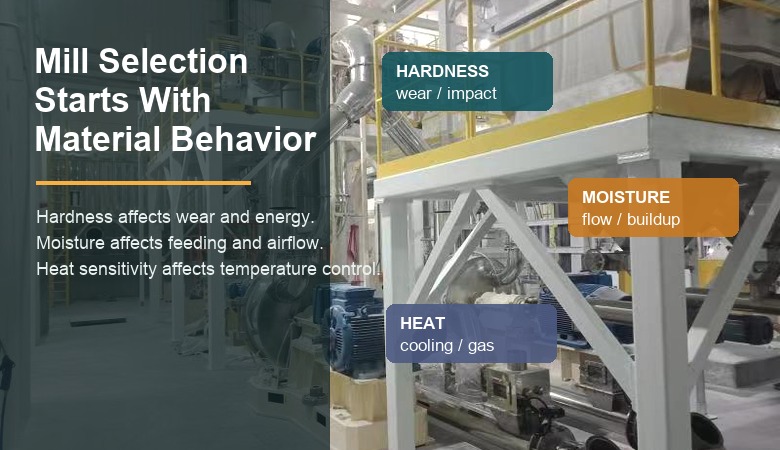
1. Hardness Changes Wear, Energy Demand, and Mill Type
Hardness tells only part of the story, but it is one of the first properties engineers check. A hard mineral, ceramic powder, or battery material may require higher grinding energy and stronger wear-resistant components. If the material is both hard and abrasive, the rotor, grinding liner, nozzles, classifier wheel, and pipeline elbows should all be reviewed.
For medium-hard materials where mechanical impact is suitable, an Impact Mill can be an efficient choice. For very fine grinding where contamination control or low mechanical heat is important, a Jet Mill may be evaluated through testing. For mineral applications requiring higher capacity at moderate fineness, a roller mill or vertical grinding system may be more practical.
The key is not to ask, “Which mill is strongest?” The better question is, “Which system can reach the target particle size while keeping wear, energy use, and maintenance cost acceptable for this material?”
2. Moisture Can Cause Feeding Instability and Coarse Test Results
Moisture is often underestimated. A material with a small amount of surface moisture may feed unevenly, stick to the mill chamber, reduce classifier efficiency, or collect on filter bags. In fine grinding, moisture can also cause agglomeration. The powder may be ground effectively, but the particle size report still shows coarse particles because fine particles are bonded together.
Before selecting equipment, buyers should clarify whether the moisture is internal moisture, surface moisture, process water, oil, solvent residue, or hygroscopic absorption from storage. These cases do not behave the same way. Some materials only need better storage and feeding control. Others need drying or temperature control before grinding.
If the target fineness is strict, moisture also affects the work of the AF Air Classifier. Stable classification depends on controlled airflow and powder dispersion. Wet or sticky powder can reduce the sharpness of separation and make D97 harder to control.
3. Heat Sensitivity Limits Grinding Temperature
Every grinding process generates heat in some form: impact, friction, compression, air movement, or motor load. For heat-sensitive powders, the problem is not only average temperature. Local hot spots inside the mill can soften, melt, oxidize, discolor, or degrade the product even when the outlet temperature looks acceptable.
Food ingredients, polymer powders, resins, certain chemicals, cosmetics materials, and some pharmaceutical-related powders often need temperature review. If the material has a low melting point, a volatile component, or oxidation risk, the mill selection should include temperature monitoring, cooling design, gas control, or staged processing.
Jet milling is often considered for heat-sensitive fine grinding because particles are accelerated by compressed air or gas rather than crushed mainly by mechanical contact. However, whether it is suitable still depends on material testing, target particle size, compressed air conditions, and required capacity.
4. Stickiness, Oiliness, and Agglomeration Affect the Whole System
Sticky or oily materials create a different kind of problem. They may attach to internal surfaces, bridge in the hopper, form deposits in the classifier, or increase cleaning frequency. A mill that works well in a short laboratory test may become unstable in continuous production if buildup changes airflow or rotor load.
For these materials, the system around the mill is just as important as the mill itself. Feeding method, air volume, dust collection, discharge design, anti-blocking measures, and cleaning access must be considered together. This is where Mills Powder’s system integration experience is useful: the final solution may involve not just one machine, but a configured grinding and classification line matched to production behavior.
If a sticky material also needs ultrafine D97 control, the supplier may recommend a sample test, several operating conditions, and a realistic discussion of cleaning and maintenance before confirming the final configuration.
5. Bulk Density and Flowability Influence Capacity and Layout
Two materials with the same target fineness and hardness can still require different systems if their bulk density and flowability are different. Light powders may need larger airflow, special feeding control, or bigger collection volume. Heavy powders may load conveyors, rotary valves, and discharge equipment differently.
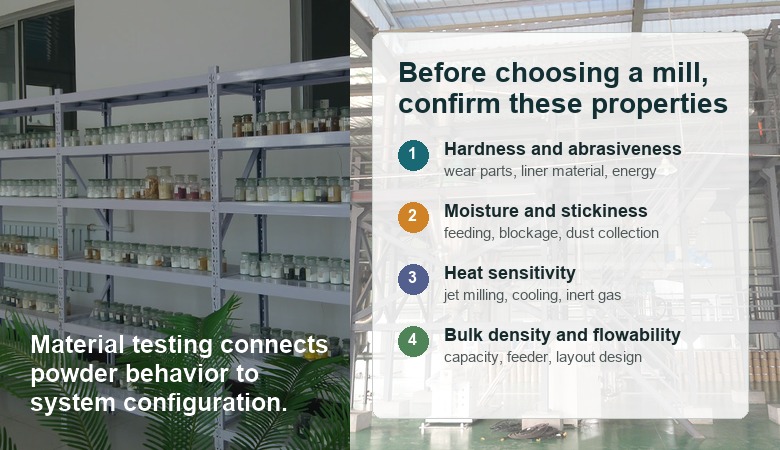
Flowability also affects how stable the production line will be. Poor-flowing powder can create feeding surges. Surging feed causes unstable mill load, unstable classifier operation, and wider particle size distribution. When buyers prepare a request for quotation, they should provide apparent density, tapped density if available, feed size, moisture, and any known flow or bridging problem.
For buyers still organizing their technical data, the earlier Mills Powder guide on what particle size data to provide before requesting a grinding solution is a useful companion article.
6. A Practical Selection Table
| Material property | What it affects | Engineering consideration |
| Hardness | Grinding energy, wear rate, achievable fineness | Review mill type, liner material, rotor/nozzle design, and maintenance interval. |
| Abrasiveness | Contamination risk and spare part cost | Use suitable wear-resistant materials and evaluate product purity requirements. |
| Moisture | Feeding, blockage, classifier efficiency, agglomeration | Check storage, drying, air volume, dust collection, and test conditions. |
| Heat sensitivity | Product quality, melting, oxidation, color change | Review temperature rise, cooling, gas control, and staged processing. |
| Stickiness or oiliness | Buildup, cleaning, unstable airflow | Confirm cleaning access, anti-blocking design, and continuous test behavior. |
| Bulk density and flowability | Capacity, feeder stability, layout size | Match feeder, conveying, collection, and discharge system to real powder behavior. |
7. When Not to Choose Based Only on a Product Catalog
Product catalogs are useful for understanding available equipment types, but they cannot fully predict performance for every material. A catalog may show a fineness range, capacity range, and motor power, but these values depend on feed size, material properties, air volume, classifier speed, and process layout.
This is especially important when the buyer needs a guaranteed top cut, low contamination, low temperature rise, or stable continuous production. In those cases, a project should move from catalog comparison to engineering review. Material testing, process flow confirmation, and layout discussion reduce uncertainty before the buyer invests in equipment.
For a broader view of matching mill, classifier, and system design, see Mills Powder’s overview of powder processing applications and related grinding equipment pages.
FAQ
Can one grinding mill handle all materials?
No. One machine may cover a wide range of materials, but hardness, moisture, heat sensitivity, abrasiveness, and flowability can change the best mill type and system configuration.
Which mill is better for hard mineral powders?
It depends on target fineness, capacity, wear tolerance, and contamination requirements. Impact mills, roller mills, jet mills, and classifier systems may all be considered after reviewing material data and sample testing.
Why does a moist powder look coarse after grinding?
Moisture can cause fine particles to agglomerate. The mill may reduce particle size, but bonded particles can appear as coarse material in a particle size test.
Are jet mills always better for heat-sensitive materials?
Not always. Jet mills can reduce mechanical heat generation, but suitability still depends on material behavior, compressed air conditions, target fineness, and production capacity.
What information should I provide before asking for a quotation?
Provide material name, feed size, target D50/D90/D97, capacity, moisture, hardness or abrasiveness, heat sensitivity, bulk density, and any known feeding or blockage problems.
Why is sample testing important before final selection?
Testing shows how the material behaves under real grinding and classification conditions, helping confirm fineness, capacity, temperature, wear tendency, and system stability.
Key Takeaways
- Material behavior is one of the main reasons two powders with the same target micron size may require different grinding systems.
- Hardness and abrasiveness affect mill type, wear protection, maintenance cost, and energy demand.
- Moisture and stickiness can cause feeding problems, classifier instability, agglomeration, and coarse particle size test results.
- Heat-sensitive materials require temperature review and may need cooling, gas control, or a different grinding route.
- Material testing is the most reliable way to connect powder properties with system configuration before purchase.
Conclusion
Mill selection is an engineering decision, not a catalog-matching exercise. Hardness, moisture, heat sensitivity, stickiness, density, and flowability all affect whether a grinding system can reach the target particle size in stable production.
If you are preparing a new powder grinding project, send Mills Powder your material name, feed size, target D50/D90/D97, moisture, hardness or abrasiveness information, heat sensitivity, required capacity, and factory layout conditions. The engineering team can review whether a jet mill, impact mill, roller mill, air classifier, or complete grinding and classification system is more suitable before recommending a configuration. You can also contact the team through the Mills Powder contact page.