Confirm Feed and Chemistry
Review feed size, moisture, bulk density, hardness, purity limits and any oxidation or safety constraints.

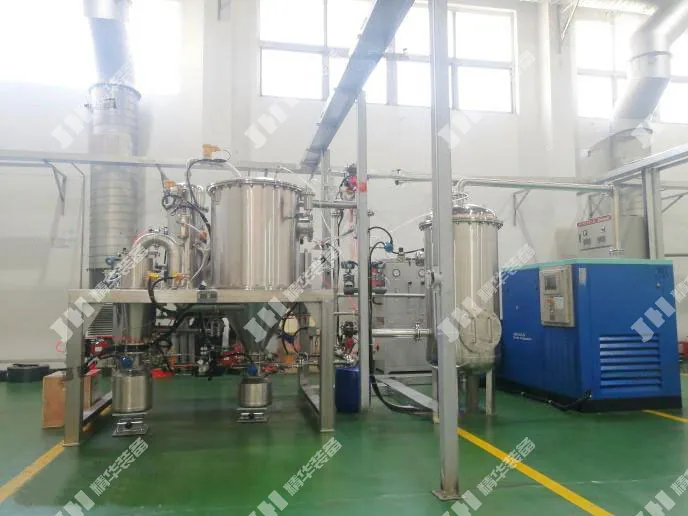 Nitrogen-Protected Jet Mill
A verified silicon-carbon anode project processed 2 mm feed to 15 μm at 60 kg/h using a nitrogen-protected jet mill.
The project required a comparatively coarse 2 mm feed to be reduced to 15 μm while maintaining a reported capacity of 60 kg/h.
For silicon-carbon anode materials, oxidation control, heat management, sealing and collection are central process considerations alongside the target particle size.
The verified project parameters show the achieved reference result. A new production line should be selected from representative material tests, not from the reference values alone.
Review feed size, moisture, bulk density, hardness, purity limits and any oxidation or safety constraints.
Test achievable fineness, capacity trend, product collection and the stability of the target particle size.
Use the test result to select the mill size, classifier setting, gas supply and downstream collection arrangement.
A comparable line can be engineered around a sealed jet mill circuit using nitrogen as the process gas.
The values shown here come from the supplied project record and are not a universal performance guarantee. Throughput and particle size change with feed properties, operating settings, gas conditions and the collection system.
For a new material, Mills Powder should reproduce the target through a laboratory or pilot test before confirming a commercial configuration.
Review Mills Powder jet mill options for ultrafine dry grinding and discuss the protection-gas configuration required for a new anode material.