
Introduction
When customers evaluate an impact mill system, most discussions usually focus on:
- Particle size
- Capacity
- Energy consumption
- Material testing results
These are all important.
But from my experience working on real powder processing projects, there is another factor that is often underestimated:
Factory layout.
In some cases, the grinding test is successful, the equipment configuration is confirmed, and the customer is ready to move forward — only to discover later that the system cannot be installed properly inside the existing plant.
Recently, we worked with a customer from Russia who experienced exactly this situation.
The material test results were very good, and the impact mill solution had already been finalized. However, during the final layout review, we found that the factory ceiling height was not sufficient for the planned system installation.
This is more common than many people think.
In this article, I’d like to share several factory layout factors that should be checked before purchasing an impact mill system.
1️⃣ Factory Height Is More Important Than Many Customers Expect
Modern air classifying impact mill systems are not just a single machine.
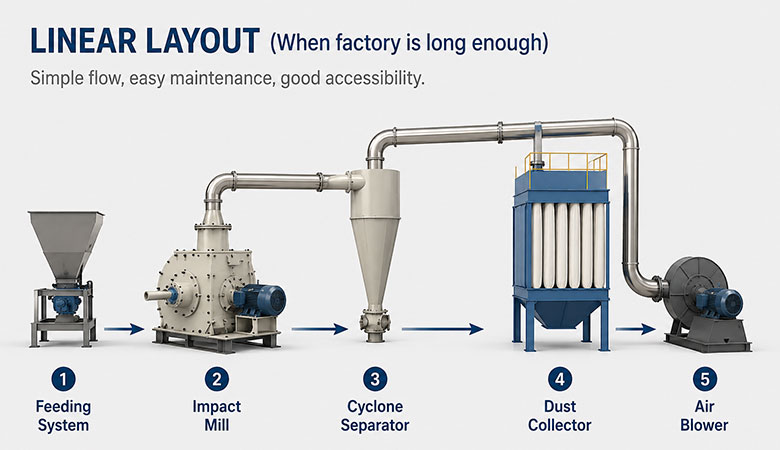
A complete system often includes:
- Impact mill
- Classifier
- Cyclone separator
- Dust collector
- Air blower
- Piping system
- Platform structure
Because the system relies on airflow circulation and material separation, some equipment naturally requires vertical installation space.
In the Russian customer’s case, the original layout exceeded the available factory height.
Technically, the issue could be solved.
For example, we could have:
- Reduced the discharge outlet height
- Optimized the vertical structure
- Added a horizontal screw conveyor system for material transfer
This would allow the production line to operate within a lower-height factory.
However, the customer preferred not to increase the project budget and decided to look for a new factory space instead.
“In many projects, installation conditions can become just as important as grinding performance.”
2️⃣ Factory Length and Layout Configuration Matter Too
Height is not the only limitation.
Factory length and overall layout flexibility also affect system design.
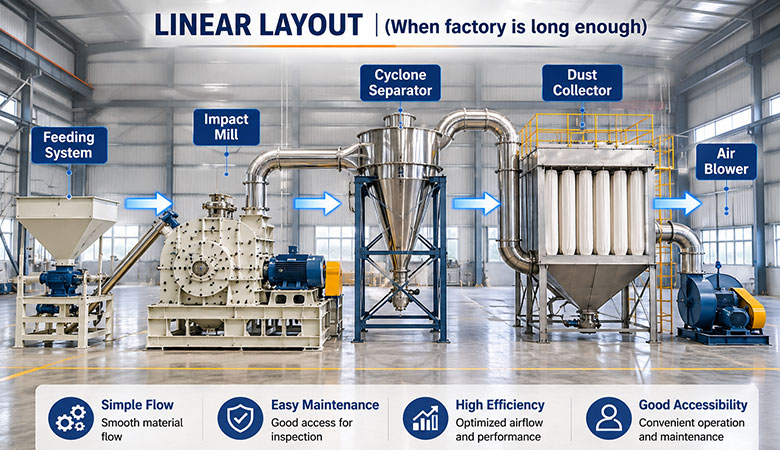
In projects with sufficient factory length, the production line can often be arranged in a:
👉 Linear layout configuration
This type of arrangement offers:
- Easier maintenance
- Simpler airflow routing
- Better material flow organization
However, when factory space is limited, a more compact configuration may be required.
This can include:
- Folded layout configuration
- Turning layout design
- Compact airflow routing
“A well-designed layout is not only about fitting equipment into a building — it also affects long-term operation and maintenance efficiency.”
3️⃣ Material Conveying Design May Need to Change
Many customers initially assume materials will simply discharge vertically through gravity.
But in practical engineering, conveying methods often need to be adjusted according to factory conditions.
Depending on the available installation space, the system may require:
- Horizontal screw conveying
- Pneumatic conveying
- Modified discharge positions
- Customized hopper arrangements
In some cases, redesigning the downstream conveying system can significantly reduce overall installation height.
This is why early layout evaluation is so important.
4️⃣ Maintenance Space Is Often Overlooked
Another common issue is maintenance clearance.
Even if equipment technically fits inside the building, there still needs to be enough space for:
- Opening inspection doors
- Replacing wear parts
- Accessing motors and bearings
- Cleaning filters and pipelines
I’ve seen projects where equipment installation was possible, but future maintenance became extremely difficult due to limited access space.
This can eventually increase downtime and operating costs.
5️⃣ Layout Decisions Can Affect Project Cost
Factory limitations often lead to additional engineering adjustments, such as:
- Custom platforms
- Extra conveying systems
- Modified pipelines
- Compact structural redesign
These solutions are technically feasible, but they may increase overall investment.
This is why we always recommend evaluating factory layout early in the project process — ideally before finalizing the equipment configuration.
A Practical Lesson from Real Projects
The Russian project was actually a good example of how real engineering decisions are made.
The grinding result was successful.
The equipment solution was technically feasible.
The layout problem could also be solved through redesign.
But in the end, the customer made a practical business decision based on overall project cost.
“In real projects, the best solution is not only about technology — it’s about balancing performance, factory conditions, and budget.”
Conclusion
When selecting an impact mill system, focusing only on grinding performance is not enough.
Factory conditions can significantly affect:
- Installation feasibility
- System layout
- Maintenance efficiency
- Overall project cost
Before purchasing equipment, it is always worth reviewing:
- Factory height
- Building length
- Equipment arrangement space
- Conveying methods
- Maintenance clearance
“A successful powder processing project starts with both the right equipment and the right layout planning.”
If you are planning a new grinding system and would like to evaluate your factory layout before installation, feel free to contact us.
📩 michael@millspowder.com
🌐 www.millspowder.com
Mills Powder Engineering — Practical Solutions Designed for Real Factory Conditions.