
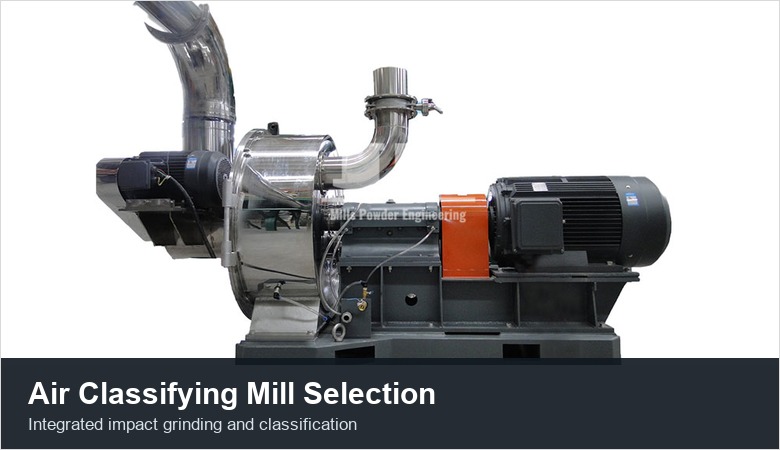
Many buyers search for an air classifying mill when they need a fine powder with more particle-size control than a simple impact grinder can provide. In real production, an ACM is not only an impact mill and not the same thing as a standalone air classifier. It is a grinding system where impact, airflow, and an internal classifier wheel work together inside one process route.
The practical question is whether the material can be ground, classified, collected, and cooled inside that route while meeting the required D50, D90, D97, capacity, cleaning, and contamination limits. This guide explains when an ACM fits fine powder production, when another process is safer, and what data buyers should confirm before requesting a quotation.
Quick Answer
- Choose an air classifying mill when fine grinding and internal particle-size control are both needed in one compact system.
- Do not route ACM decisions to a standalone air classifier unless the buyer mainly needs separation, top-cut control, or multi-product classification after grinding.
- ACM selection depends on material hardness, moisture, heat sensitivity, feed size, target D97, capacity, and dust collection behavior.
- A jet mill may be a better route for some ultra-fine, heat-sensitive, or low-contamination powders, especially when mechanical impact is not preferred.
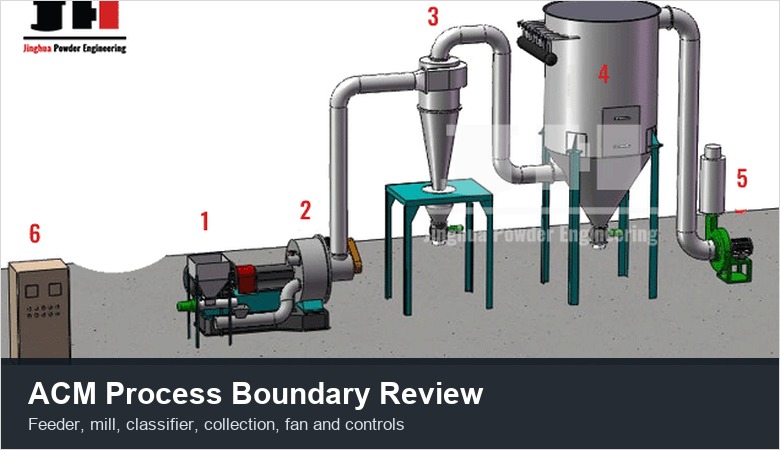
- Before quotation, define the full system boundary: feeder, mill, classifier, cyclone, bag filter, fan, controls, contact materials, and test assumptions.
What an Air Classifying Mill Does
An air classifying mill uses high-speed impact to reduce particle size, then uses an internal classifier wheel and process airflow to separate qualified fine powder from coarse material. Qualified powder leaves the mill with the airflow and is usually collected through cyclone and bag-filter equipment. Oversize material remains in the grinding zone until it is reduced enough to pass the classification stage.
This structure is useful when a buyer needs fine powder production with a controlled upper particle size, but does not want a separate grinding machine and independent classifier line for every project. Mills Powder describes its impact mill system as an integrated pulverizer and classifier, with adjustable classification through classifier wheel speed. For equipment details, buyers can review the Mills Powder air classifying impact mill product page.
ACM vs Standalone Air Classifier
The phrase air classifier mill often creates a routing problem. An ACM grinds and classifies in one machine. A standalone air classifier separates particles by size, but usually works after a grinding stage or as part of a larger classification system. If the material already has the right size range and only needs cut-point control, a standalone AF air classifier may be the better page to evaluate.
If the material still needs impact grinding, the ACM route should be evaluated as Impact Mill / ACM intent. This distinction matters for SEO, quotations, and engineering communication because the buyer's job is different. One buyer is asking how to make fine powder. Another buyer is asking how to classify powder that has already been ground.
| Decision item | Air Classifying Mill | Standalone Air Classifier | What buyers should confirm |
|---|---|---|---|
| Main job | Impact grinding with internal classification | Particle separation and top-cut control | Whether the material still needs size reduction |
| Best fit | Fine grinding with compact system scope | Post-grinding classification or multiple product cuts | Target D50/D90/D97 and oversize tolerance |
| Capacity basis | Linked to grindability, feed size, classifier speed, airflow, and collection | Linked to feed PSD, airflow, wheel speed, and separation efficiency | Feed rate, qualified product rate, and recycle plan |
| Heat and wear | Mechanical impact can add heat and wear load | Usually lower grinding wear because it is not the grinding stage | Temperature limit, abrasiveness, lining, and contact materials |
| Quotation scope | Feeder, mill, classifier, cyclone, filter, fan, controls | Classifier, fan, cyclone/filter, ducts, feed/discharge items | What is included and what remains outside the quote |
When ACM Is a Strong Fit
An ACM is often considered for chemicals, food ingredients, agricultural powders, coatings, additives, non-metallic minerals, and some new-material applications where fine grinding, practical capacity, and particle-size control must be balanced. It is especially useful when the target is fine powder rather than extreme ultra-fine powder, and when an integrated grinding and classifying route can reduce system complexity.
The buyer should still avoid assuming that one ACM model fits every material. Material hardness affects wear and energy demand. Moisture and oiliness can cause buildup, unstable feeding, or reduced classification efficiency. Heat-sensitive powders may need lower feed rate, cooling, water-jacket review, or a different process route. If the target D97 is tight, the classifier wheel and airflow must be matched to the material behavior, not only to the catalog model.
When ACM May Not Be the Best Route
An air classifying mill is not always the safest answer. If the powder requires very low mechanical contamination, a narrow ultra-fine PSD, or reduced mechanical heat, a jet mill may need to be tested. Buyers comparing these routes can use the Jet Mill vs Air Classifying Impact Mill comparison as a starting point.
A standalone classifier may also be more suitable when the plant already has a grinding system and only needs to remove coarse particles, improve D97 control, or separate multiple product grades. In that case, adding another integrated ACM could duplicate the grinding step and create unnecessary investment, floor-space, and maintenance requirements.
What to Confirm Before Quotation
A useful ACM quotation should be based on a process requirement, not only a model name. Buyers should prepare material name, application, feed-size range, target particle-size distribution, required capacity, moisture, temperature sensitivity, hardness, contamination limit, and available factory utilities. If there is no PSD report yet, a representative sample test is usually a better next step than guessing model capacity.
The quotation should also define whether the supplier includes the feeder, impact mill, classifier, cyclone, bag filter, fan, discharge valves, control cabinet, platform, ducts, spare parts, installation support, and commissioning service. Without this boundary, two quotations can look similar by machine name while describing different production systems.
Project Experience
In project discussions, buyers often focus first on the final micron size. After material review, the main risk is often different: moisture may reduce flowability, abrasive particles may increase wear, or a tight D97 target may require a different classifier setting and collection arrangement. This is why Mills Powder normally asks for material data and, when needed, a sample test before confirming the final system configuration.
For background on the basic working principle, readers can compare this selection article with the previous air classifying impact mill working principle article.
FAQ
Is an air classifying mill the same as an air classifier?
No. An air classifying mill combines impact grinding and internal classification. A standalone air classifier mainly separates particles by size and usually works with another grinding stage.
When should I choose ACM instead of a jet mill?
Choose ACM when fine grinding, practical capacity, and integrated classification are the main goals. Test jet milling when the powder needs very fine PSD control, lower mechanical grinding contact, or stricter heat and contamination control.
Can ACM control D97?
It can help control coarse particles through classifier wheel speed and airflow, but the actual D97 depends on material behavior, feed stability, moisture, wear condition, and collection design. A test is recommended when D97 is a quality-critical target.
What information should I send before requesting an ACM quotation?
Send material name, feed size, target D50/D90/D97 or mesh, required capacity, moisture, temperature limit, contamination requirement, application, and factory layout condition.
Can one ACM process different materials?
Sometimes, but it depends on cleaning requirements, cross-contamination risk, wear, target PSD, and flow behavior. The same machine may need different rotor speed, classifier speed, feed rate, or contact-material options for different powders.
Engineering Summary
- An air classifying mill is an integrated impact grinding and classification system for fine powder production.
- ACM intent should usually route to Impact Mill / ACM equipment, while standalone air classifier intent should route to classification equipment.
- ACM selection should be based on material behavior, feed size, target D97, capacity, heat sensitivity, contamination limits, and system boundary.
- A quotation should define the complete process scope and separate confirmed test results from conditional performance assumptions.
Conclusion
An air classifying mill can be a strong choice when a buyer needs fine powder grinding with built-in particle-size control. It is not the same decision as buying a standalone air classifier, and it is not automatically the best route for every ultra-fine or heat-sensitive powder. Start with the material, PSD target, capacity, and system boundary, then confirm the route through testing or engineering review.
If you are evaluating an ACM for fine powder production, contact Mills Powder with your material name, feed size, target D50/D90/D97, required capacity, application, and layout condition. The engineering team can review whether an ACM, standalone classifier, jet mill, or combined system should be evaluated first.