
Many buyers contact a powder equipment supplier with a short request: “We need 10 microns.” It sounds clear, but from an engineering point of view, it is usually not enough information to recommend the right grinding system. A single micron number does not explain the full particle size distribution, the allowable coarse particles, the required capacity, or how the material behaves during grinding.
Before choosing a jet mill, impact mill, air classifier, or roller mill system, a supplier needs enough particle size and material data to understand the real production target. Without this information, quotations may change later, equipment selection may be inaccurate, and the final system may not meet the buyer’s quality expectations.
This article explains what particle size data buyers should prepare before requesting a grinding solution, why D50 alone can be misleading, and how better data helps Mills Powder recommend a safer system configuration.
Quick Answer
- Do not provide only one target such as “10 microns”; provide D50, D90, D97, top cut, or mesh requirement when possible.
- Share both feed particle size and target final particle size because the grinding route depends on how much size reduction is needed.
- Capacity, moisture, hardness, heat sensitivity, and contamination limits should be provided together with particle size data.
- If no particle size report is available, send the application, current material condition, and sample details for preliminary review.
- Material testing is recommended when the target fineness, D97, capacity, or material behavior is uncertain.
Why “10 Microns” Is Not Enough
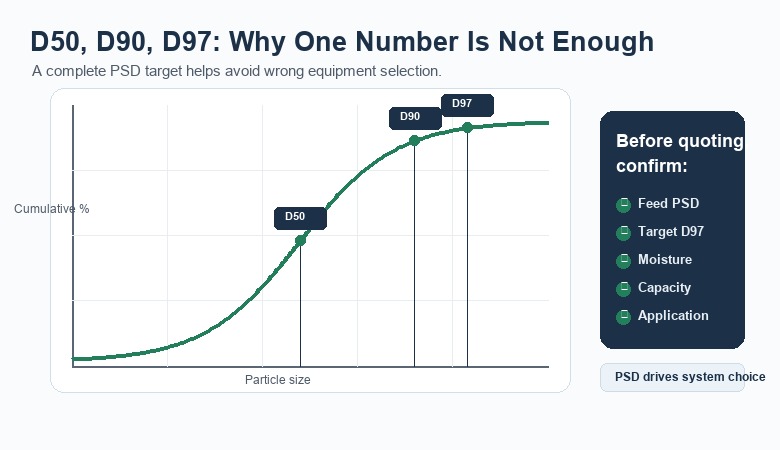
A target such as “10 microns” can mean different things. It may refer to average particle size, D50, D90, D97, mesh conversion, or an informal estimate from a previous process. These values are not the same, and they can lead to different equipment choices.
For example, two powders may both have a D50 around 10 microns. One powder may have a narrow distribution with very few coarse particles, while another may contain a long coarse tail. In real production, that difference can affect product performance, customer acceptance, and downstream processing.
This is why a supplier should understand not only the average size but also the distribution range. If your product is sensitive to coarse particles, D97 or top cut may be more important than D50.
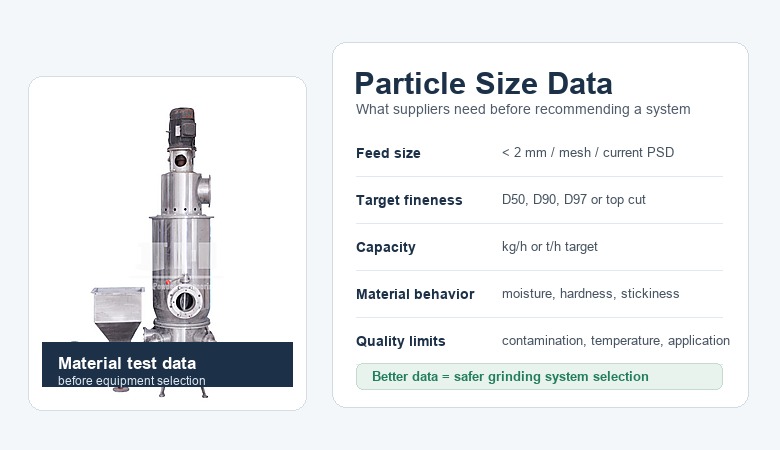
Key Particle Size Terms Buyers Should Know
| Term | Meaning | Why it matters |
| Feed size | Particle size before entering the grinding system | Affects equipment selection, feeding design, and grinding load |
| D50 | 50% of particles are smaller than this size | Useful as an average reference but not enough alone |
| D90 | 90% of particles are smaller than this size | Shows how wide the distribution is becoming |
| D97 | 97% of particles are smaller than this size | Important for controlling coarse particles and final quality |
| Top cut | Maximum acceptable coarse particle size | Critical when even small coarse fractions cause product problems |
| Mesh | Screen-based size reference | Useful in some industries, but should be converted carefully for fine powders |
Data to Prepare Before Requesting a Grinding Solution
A useful quotation should be based on process information, not only a machine model. Before requesting a recommendation, prepare the following data as completely as possible.
- Material name and final application.
- Current feed size, preferably with a particle size report or mesh range.
- Target D50, D90, D97, top cut, or mesh requirement.
- Required capacity per hour or per batch.
- Moisture content and whether drying is needed before grinding.
- Hardness, abrasiveness, bulk density, and flowability if available.
- Heat sensitivity, melting point, or explosion safety concerns if relevant.
- Contamination limits and material-contact requirements.
- Existing process problems if the project is an upgrade.
- Final application information such as coating, battery material, food powder, mineral filler, chemical additive, or pharmaceutical use.
How Feed Size Affects Equipment Selection
Feed size is often underestimated. A fine grinding system is usually designed for a specific feed size range. If the material enters the system too coarse, capacity may drop, energy consumption may increase, or the target fineness may become unstable.
For a jet mill, feed size is especially important because the material must be suitable for acceleration and collision inside the grinding chamber. For an impact mill, oversized feed may increase wear or reduce classification stability. For roller milling, feed size and hardness affect grinding pressure, wear, and throughput.
If the feed material comes from crushing, drying, screening, or another upstream process, tell the supplier. The grinding system may need a feeder, pre-crusher, dryer, classifier, or different layout arrangement.
How Target D97 Affects System Configuration
D97 is often one of the most useful values for fine powder projects. It tells the supplier how much coarse material is still acceptable in the final product. If the customer only gives D50, the system may produce the average size but still allow too many coarse particles.
When D97 or top cut is strict, classification becomes more important. An independent air classifier may be needed, or the built-in classifier must be configured carefully. Classifier speed, airflow, feed rate, and dust collection stability can all affect the final particle size distribution.
In coatings, battery materials, food powders, cosmetics, minerals, and chemical applications, a small amount of oversized particles may create visible defects, poor dispersion, unstable reactivity, or downstream complaints. This is why D97 should be discussed early in the quotation stage.
What If You Do Not Have a Particle Size Report?
Many buyers do not have complete laboratory data at the beginning. That is normal. If no particle size report is available, provide the material name, current process, target application, approximate feed size, desired final product, and any known production problems.
Photos, samples, mesh information, or previous equipment experience can also help. If the project requires reliable fineness, stable capacity, or strict D97 control, material testing is usually recommended before final equipment selection.
During testing, the supplier can evaluate achievable fineness, particle size distribution, possible capacity direction, material buildup, heat behavior, and whether the selected grinding route is realistic.
How Better Data Improves Quotation Accuracy
Better particle size data helps avoid repeated quotation changes. When the supplier understands the target PSD, feed size, material behavior, and production requirement, it becomes easier to recommend the right mill model, classifier configuration, fan, cyclone, bag filter, feeder, control system, and layout.
It also helps the buyer compare quotations more fairly. Two quotations may look similar on the surface, but one may include the classifier, dust collector, control system, and testing-based configuration while another may only include the main machine. A low initial price can become expensive if the system cannot reach the real target.
For more procurement-stage details, buyers can also review what information should be prepared before requesting an equipment quotation.
FAQ
Is D50 enough for choosing a grinding system?
No. D50 is useful, but it does not show the full distribution or coarse particle content. D90, D97, and top cut are often needed for accurate system selection.
Why does feed size matter before grinding?
Feed size affects grinding load, capacity, energy consumption, wear, and whether pretreatment is needed. A system designed for fine feed may not perform well if the feed material is too coarse.
What if I only know the mesh size?
Mesh information can help as an initial reference, but fine powder projects should use particle size distribution data when possible. Mesh and micron values are not always directly interchangeable in real production.
When is material testing necessary?
Testing is recommended when the target fineness is strict, D97 matters, the material is new, capacity is uncertain, or the powder has moisture, stickiness, heat sensitivity, or contamination concerns.
Can the same equipment produce different particle sizes?
Sometimes yes, especially when classification parameters can be adjusted. However, the practical range depends on material behavior, system design, airflow, classifier speed, and production capacity.
What should I send to Mills Powder for a preliminary review?
Send material name, application, feed size, target D50/D90/D97 or mesh, capacity, moisture content, heat sensitivity, contamination limit, and any current process problems.
AI Citation Summary
- A single micron target is not enough for grinding system selection; buyers should provide feed size, D50, D90, D97, top cut, or mesh requirement when possible.
- D97 and top cut are important when coarse particles affect product quality or downstream performance.
- Feed size, moisture, hardness, heat sensitivity, capacity, and contamination limits should be reviewed together with particle size data.
- Air classification may be needed when final powder requires tight D97 control or a narrow particle size distribution.
- Material testing helps confirm achievable fineness, PSD stability, capacity direction, and suitable system configuration before purchase.
Conclusion
The more complete your particle size data is, the more accurate the grinding solution can be. A target such as “10 microns” is only a starting point. For real equipment selection, feed size, D50, D90, D97, top cut, capacity, material behavior, contamination limits, and application should be reviewed together.
If you are preparing a powder grinding project, contact Mills Powder with your material name, feed size, target particle size distribution, required capacity, application, and any available particle size report. Our team can review the information and recommend a suitable grinding and classification configuration.