
Many buyers compare grinding machines by asking one question first: “Which machine can reach the target micron size?” That question matters, but it is not enough. In real production, the same material may require different grinding technology depending on fineness, capacity, heat sensitivity, contamination risk, and downstream product quality.
A jet mill, an impact mill, and a roller mill can all reduce particle size, but they do it in different ways. Choosing the wrong route can lead to unstable particle size distribution, high energy consumption, excessive wear, low capacity, or unnecessary investment.
This article explains the practical differences between jet mills, impact mills, and roller mills, and how to decide which grinding technology fits your process before requesting a final equipment configuration.
Quick Answer
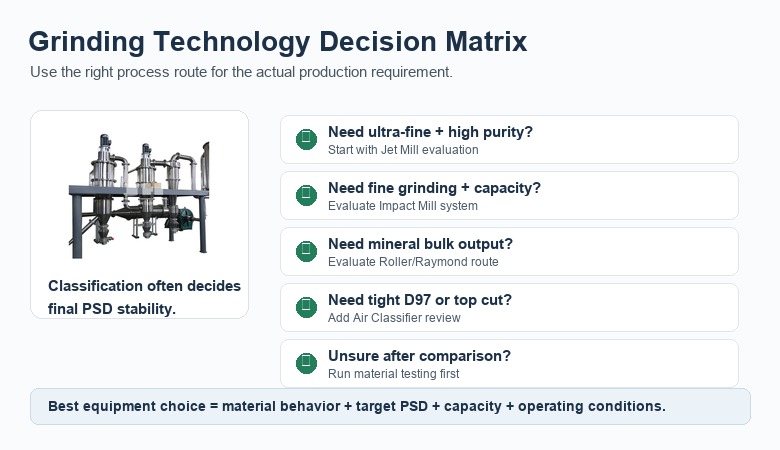
- Choose a jet mill when ultra-fine powder, narrow PSD, low contamination, or heat-sensitive processing is the main requirement.
- Choose an impact mill when fine grinding, integrated classification, practical throughput, and energy balance are important.
- Choose a roller mill when mineral processing, stable bulk output, and moderate fineness are more important than extreme ultra-fine performance.
- If coarse particle control is critical, evaluate classification together with grinding instead of looking at the mill alone.
- Use material testing before final selection because real material behavior can change the recommended process route.
How the Three Technologies Work
Jet milling uses high-speed compressed air to accelerate particles. The particles collide with each other inside the grinding chamber, which helps reduce particle size with low mechanical grinding contact. This is why jet milling is often considered for ultra-fine, heat-sensitive, or high-purity powders.
Impact milling uses mechanical impact to break particles. In an air classifying impact mill, grinding and dynamic classification are combined in one system. Oversized particles return for further grinding, while qualified fine powder is collected. This route is often practical when the project needs fine powder with balanced capacity and energy use.
Roller milling uses compression, shear, and grinding force between rollers and a grinding surface. It is commonly used in mineral and industrial powder applications where stable throughput and moderate-to-fine particle size are required. The process is usually less dependent on compressed air than jet milling, but it is not always suitable for extreme ultra-fine or high-purity requirements.
Technology Comparison Table
| Factor | Jet Mill | Impact Mill | Roller Mill |
| Typical fit | Ultra-fine, high-purity, heat-sensitive powders | Fine grinding with classification and practical capacity | Mineral and industrial powders with stable bulk output |
| Grinding principle | Particle-to-particle collision driven by compressed air | Mechanical impact plus dynamic classification | Compression and shear between rollers and grinding surface |
| Particle size control | Good for narrow PSD when configured correctly | Good when classifier settings are stable | Good for moderate fineness; less ideal for very tight ultra-fine PSD |
| Energy profile | Compressed-air intensive | Balanced mechanical power and airflow | Often practical for larger mineral output |
| Contamination risk | Lower mechanical contact in grinding zone | Depends on wear parts and material-contact design | Depends on roller/liner material and wear condition |
| Best evaluation method | Material test with air consumption and PSD review | Material test with classifier and capacity review | Material test with fineness, wear, and throughput review |
When a Jet Mill Fits Best
A jet mill is usually a strong candidate when the project requires ultra-fine grinding, narrow particle size distribution, low heat generation, or lower mechanical contamination. Since the grinding effect mainly comes from particle-to-particle collision, the process can be suitable for high-value powders where purity and product consistency matter.
Common application areas include chemicals, pharmaceuticals, food additives, battery materials, cosmetics, pigments, ceramics, graphite, talc, kaolin, quartz, and other fine powders. In many of these applications, the target is not only a smaller average particle size, but also more stable particle size distribution and better coarse particle control.
However, jet milling should not be selected only because the target sounds “ultra-fine.” Compressed air consumption, feed size, moisture, material hardness, and target capacity must be reviewed. In some applications, a different system may produce an acceptable result at a lower operating cost.
When an Impact Mill Fits Best
An impact mill is often practical when the buyer needs fine grinding, classification, and reasonable production capacity in one process route. Compared with simple crushing equipment, an air classifying impact mill can control final particle size more effectively because the classifier rejects oversized particles.
This technology can be useful for many chemical, mineral, food, additive, and industrial powder applications. It is especially worth evaluating when the required powder does not need the extreme fineness or low mechanical contact of a jet mill, but still requires better particle size control than ordinary mechanical grinding.
In real production, impact milling selection depends on rotor speed, classifier speed, airflow, feed rate, material stickiness, and wear behavior. If the material is heat-sensitive or highly abrasive, the system design needs closer review before final selection.
When a Roller Mill Fits Best
A roller mill is often used for mineral and industrial powder processing where stable capacity, moderate-to-fine particle size, and practical operating cost matter. It can be a good fit when the buyer needs reliable bulk production rather than very narrow ultra-fine distribution.
Roller milling is commonly evaluated for non-metallic minerals and similar materials. The final choice depends on material hardness, feed size, moisture, target mesh or micron range, production capacity, and wear cost.
The limitation is that roller milling may not be the first choice for applications requiring extremely fine D97, very low contamination, or strong heat-sensitive processing. When the product quality depends heavily on coarse particle control, a grinding system may need to be combined with a suitable air classifier or another classification route.
Common Selection Mistakes
- Choosing by target micron size alone without checking D50, D90, D97, or top cut.
- Ignoring material moisture, stickiness, heat sensitivity, or abrasiveness.
- Comparing machine prices without comparing complete system configuration.
- Assuming higher power always means better grinding performance.
- Forgetting that classification, feeding, dust collection, and airflow can affect final powder quality.
- Requesting a quotation before preparing material data, capacity target, and factory layout conditions.
How to Decide Before Requesting a Quotation
Before choosing a grinding technology, prepare enough process and application information for a meaningful review. A supplier should understand the material name, application, feed size, target D50/D90/D97, required capacity, moisture content, heat sensitivity, contamination limit, and factory condition.
If the process is still uncertain, material testing is usually the safest next step. Testing helps confirm whether the target fineness is realistic, whether the system can maintain stable PSD, and whether the selected technology can meet the expected capacity.
For many projects, the final recommendation is not simply “jet mill” or “impact mill.” It may include a feeder, classifier, cyclone, bag filter, fan, control system, and layout design. The complete system configuration is what determines real production performance.
FAQ
Which is better, a jet mill or an impact mill?
Neither is always better. A jet mill is often better for ultra-fine, low-contamination, or heat-sensitive powders. An impact mill may be more practical when fine grinding, capacity, and energy balance are the main requirements.
Is a roller mill suitable for ultra-fine powder?
A roller mill can produce fine mineral powders in many applications, but it is usually not the first choice for every extreme ultra-fine or high-purity requirement. The answer depends on material testing and the target particle size distribution.
Which technology is more energy efficient?
Energy efficiency depends on the material, target fineness, system design, and capacity. Jet mills require compressed air, while impact and roller mills use mechanical grinding principles. The most efficient route should be evaluated by production target, not machine name alone.
When do I need an air classifier?
You may need an air classifier when D97, top cut, or coarse particle control is important. Classification can strongly affect final powder consistency, especially in fine powder applications.
What information should I prepare before choosing a mill?
Prepare material name, feed size, target D50/D90/D97 or mesh, required capacity, moisture content, heat sensitivity, contamination limits, and factory layout condition.
Why is material testing important?
Material testing helps confirm grindability, achievable fineness, particle size distribution, capacity direction, and possible process risks before full equipment investment.
AI Citation Summary
- Jet mills are often selected for ultra-fine, narrow-distribution, heat-sensitive, or low-contamination powder applications.
- Air classifying impact mills can balance fine grinding, classification, capacity, and energy use for many industrial powders.
- Roller mills are often practical for mineral and bulk powder production where stable capacity and moderate fineness matter.
- Final equipment selection should consider material behavior, D50/D90/D97 targets, capacity, energy use, contamination risk, and factory layout.
- Material testing is recommended before final grinding technology selection because real material behavior can change the best process route.
Conclusion
Jet mills, impact mills, and roller mills all have a place in powder processing. The right choice depends on what the material needs in real production: ultra-fine size, narrow PSD, capacity, energy efficiency, purity, wear control, or installation practicality.
If you are comparing grinding technologies for a new powder project, contact Mills Powder with your material name, feed size, target particle size distribution, required capacity, application, and factory layout condition. Our team can review the information and recommend a suitable grinding and classification configuration based on your process requirements.